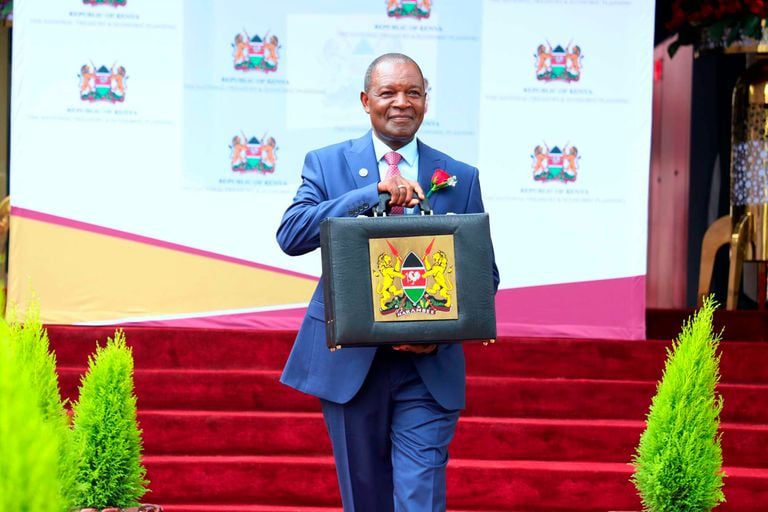
On June 30, the High Court halted the Treasury from putting the Act into effect, warning that if the petitions opposing the Act are successful, Kenyans would be forced to pay illegal taxes.
However, the CS claims that the government will likely lose around Ksh211 billion in the current fiscal year, making it challenging to carry out the 2023–24 budget as intended. According to Prof. Ndung’u, some projects must be put on hold.
The purpose of the Finance Act of 2023 was to increase tax collection, the main source of money for the execution of the national budget. The CS stated that its suspension will render the Kenyan government unable to carry out its executive duties and fulfill its financial obligations.
Prof. Ndung’u further stated that the government stands to lose money that cannot be recovered but that it still has a strong possibility of winning an appeal through Attorney General Justin Muturi.
“In order to function, the Kenyan government must borrow to close the gap. The repealed elements of the Finance Act, 2022 have the effect of affecting revenue collection, resulting in service interruptions for already budgeted revenue,” according to an affidavit from Prof. Ndung’u. This is because there are no saving provisions in the Finance Act, 2023.
Judge Mugure Thande of the High Court declared last week that issuing the requested conservatory orders had merit notwithstanding the presumption that legislation was constitutional.
In the application, Prof. Ndung’u claims that the fiscal plan has been disturbed because the expenditures and projects that would not receive funding have to account for the collections that were not received.
“The Appropriations Act is collaterally suspended by the suspended Act at both the local and federal levels. Access to integrated services and debt service are also impacted by this stoppage,” he added.
He continued by saying that “since the Act’s implementation was scheduled to start on July 1 and preparations had been made to make it easier to implement, its postponement has led to confusion.”
The CS claims that, as an illustration, the Energy and Petroleum Regulatory Authority (Epra) sent instructions on June 30 at 5 p.m. in advance of the price change.
Senator Okiya Omtatah of Busia, who is opposed to the application, claims that the Act’s suspension has no bearing on the legal methods of raising money.
He said that only the additional tax collections over those in the Finance Act of 2022 will be impacted by the suspension of the Finance Act of 2023.