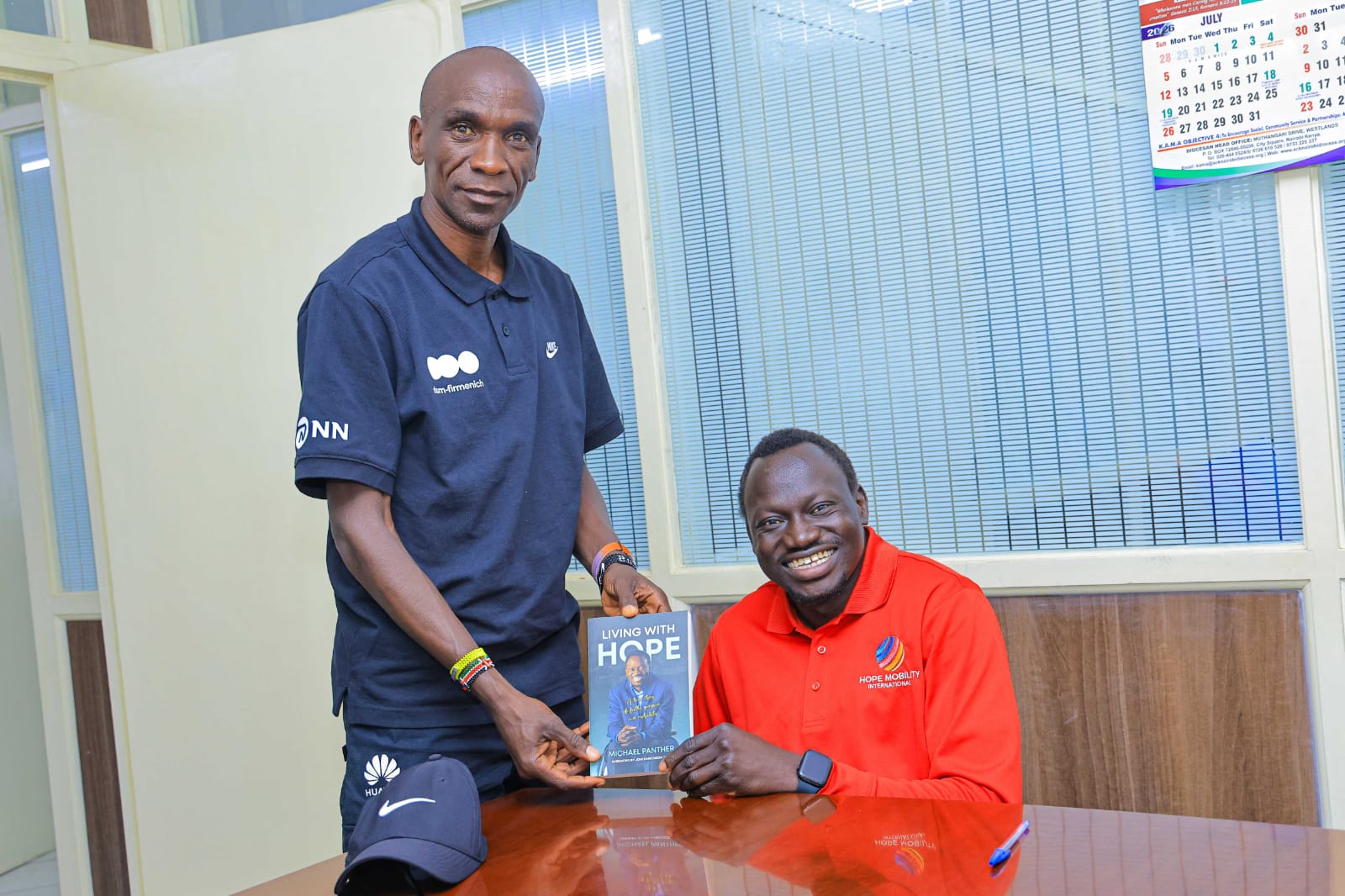
Kenyan marathon great Eliud Kipchoge has thrown his weight behind the Race for Mobility campaign, an initiative seeking to raise KSh100 million to provide specialised wheelchairs to children living with disabilities.
The campaign, spearheaded by Hope Mobility Kenya founder Michael Panther, will culminate in Panther’s participation in the 2026 Standard Chartered Nairobi Marathon on September 25.
Panther, who is a person living with disability, will compete in the 42-kilometre race using a professional racing wheelchair, dubbed “The Red Ferrari.” His participation is intended to raise awareness and mobilise resources for at least 200 custom-fitted paediatric wheelchairs.
Speaking during a courtesy visit to Panther, Kipchoge commended the initiative, describing it as an example of determination and resilience while highlighting the role of sport in promoting inclusion.
“It is really inspirational and motivational that someone who is differently abled is taking on such a rigorous exercise to impact children’s welfare. It is a show of mental resilience that will break any social and physical barrier that hinders the active participation of the vulnerable and people living with disabilities in our communities,” Kipchoge said.
The marathon champion encouraged people living with disabilities, particularly children, to explore sporting opportunities and pursue their ambitions without being limited by physical or social barriers.
“Sports have a huge platform for everybody, including children with disability. I would encourage them to take on any challenge in the different sports disciplines and conquer the world,” he said.
For Panther, the campaign is not only about completing the marathon but also creating opportunities for children with disabilities to participate more fully in society.
“I am excited to have Kipchoge here today. It gives me momentum and courage as I seek to immortalize his refrain, ‘No Human is Limited,’” Panther said.
He added that access to appropriate mobility devices could significantly improve children’s access to education, healthcare, and social interaction.
According to figures cited by the National Council for Persons with Disabilities (NCPWD), Kenya has a deficit of approximately 550,000 wheelchairs and assistive mobility devices, with children accounting for about 200,000 of the shortfall.
Panther said each specialised, custom-fitted wheelchair costs approximately KSh50,000, with the campaign focusing on ensuring that beneficiaries receive devices suited to their individual needs.
“When we provide a child with a custom-fitted wheelchair, following the WHO eight-step clinical guidelines, we ensure their safety. We don’t just move their bodies—we open the doors to the classroom and allow their mothers to return to work,” he said.
Hope Mobility Kenya plans to manufacture and distribute the wheelchairs in accordance with the World Health Organization’s eight-step wheelchair service process, which promotes proper assessment, fitting, and provision of appropriate mobility devices.
The initiative is expected to benefit children and their families by improving mobility and supporting participation in education, healthcare, and community life.
As part of the fundraising drive, Panther is appealing to individual well-wishers to pledge KSh1,000 for each of the 42 kilometres in his marathon challenge. Corporate organisations and other partners are invited to contribute any amount towards the campaign.
The Race for Mobility campaign comes as advocates for disability inclusion continue to call for greater access to assistive devices, which remain critical in enabling children living with disabilities to participate fully in education and community life.