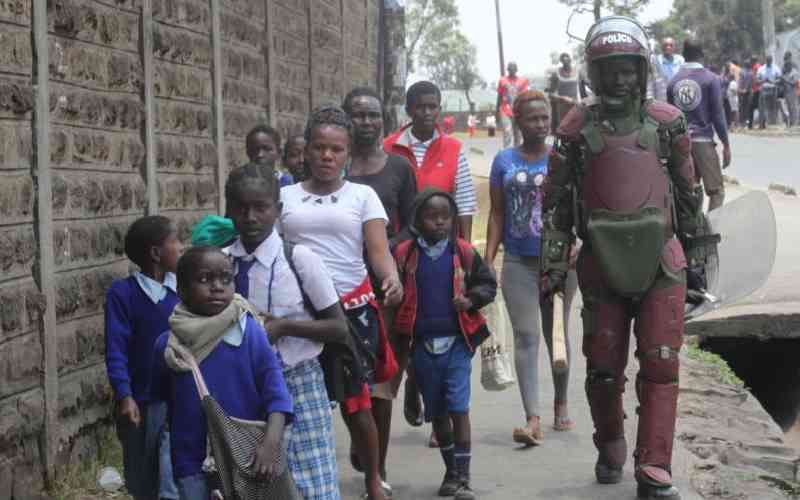
Learning time will be lost by students in primary school for 14 hours and in secondary school for roughly 20hours. Additionally, since it has been revealed that the Azimio coalition’s planned protests would begin today, protesters have been warned to stay away from educational facilities.
Kahi Indimuli, chairman of the Kenya School Heads of Association, warned that students stand to lose more if protests are not put an end to and called for talks between the government and opposition.
He also urged the police to use patience when dealing with demonstrators and stop using tear gas inside of buildings.
“The majority of elementary school students lack the knowledge and abilities to respond appropriately in these circumstances. It could result in a stampede in secondary schools, which could have disastrous consequences,” he said.
In his office at Machakos High School, Mr. Indimuli said,“For the fourth time since the start of the new term in May, he claimed, the protests will have an impact on schools.”
Schools started on May 8 and will break for two weeks starting on August 11. While some institutions only operate with a portion of their overall student and instructor population during the rally, others had their doors totally closed.
Now that the protest may potentially slow down the amount of material covered in class, this sheds light on how it may affect teaching and learning.
Education stakeholders criticized the demonstration’s effects on teaching and learning on Tuesday.
Johnson Nzioka, the chairperson of the Kenya Primary School Heads Association, issued a warning about the “significant disruption” the protests have so far caused.
He claimed that the majority of those impacted are the 70% of students who attend elementary and secondary day schools.
According to Nzioka, “increased tension from prior protests has resulted in some students and teachers skipping school, and this slows down teaching and learning ultimately leading to delayed coverage of the syllabus.”
Other interested parties issued a warning that the harm might be severe. Children and young people may be more vulnerable to abuse and violence without access to education.
On Tuesday, they urged the two at war parties to reduce political tension . According to Collins Oyuu, secretary general of the Kenya National Union of Teachers, there has been a loss of instructional time as a result of the current protests.
“One might think that an hour lost in the learning process is something that is not important, but what we lose in teaching over the course of a day translates to effects and affects the end result and even the examination of our children,” Oyuu stated.
He also denounced the violence used during recent protests against several educational institutions. At least 50 students were hospitalized last week after police fired tear gas canisters into Kihumbuini Primary School in Kangemi.
“Nobody, no genuine teacher can see this to be interesting, some of them shed tears, let alone parents of those children,” remarked Oyuu.
Akello Misori, the secretary general of KUPPET, said on Tuesday that the students’ psychological health could be harmed by the ongoing political unrest and the attacks on some schools.