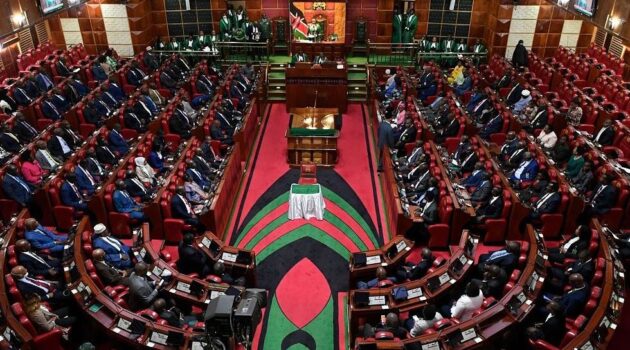
The new university funding formula has continued to stir a debate among lawmakers , with Members of Parliament demanding it’s stopping, citing gaps in ensuring equity in access to education in the country.
National Assembly Speaker Moses Wetangula, has directed Majority Leader Kimani Ichung’wah to seek a statement on the new funding model and to allay the anxiety among members which has ignited elicit reactions.
Ichung’wah emphasized that there was need for more public awareness and public participation on the new funding model. Even though it’s aimed at ensuring the more vulnerable children benefit from the government loans and scholarship.
“One of the few things we should ask the CS, and what he should do, is to ensure that not a single student is denied admission into the public university until they resolved the issues pertaining the funding. Especially the issue of age and access to loans,” he said.
Nyando MP Jared Okello, had sought a statement before the house on the implementation of the new funding model, he said that thousands of poor students risked being locked out due to hitches about by the system.
Okello has pushed for the government to revert to the old funding model, through capitations, to ensure certainty that all university students will be enrolled in the higher learning institutions.
“If this matter is left unattended, less than 20% of university students are going to report to college. When there was capitation, there was level of certainty in terms of payment of school fees. That has left to discretion of HELB and other people in the ministry,” said Okello.
He added: “If we don’t act as a house and this house has never thrown it’s hand in the air as a surrender. We are afraid we are going to lose so many brains that ought to have been plunged in the university precincts.”
Gilgil MP Martha Wangari decried that the new funding model will lock out minors who are seeking to receive loans from the government to join university.
“Where there is scramble, it’s room to breed corruption. The application of this model must be through HELB. Some people don’t even have ID. This issue is of national importance. We have some minors who wants to join university. We need to be clear in this house,” she said.
2022 KCSE candidates seeking to apply for university scholarships and loans have already commenced, the applications will now be required to follow new guidelines set by the Ministry of Education the deadline set for 27 August.
The funding model only applies to KCSE 2022 candidates who will have to make their applications on the Higher Education Financing (HEF) portal; www.hef.co.ke.
Students will be awarded scholarships, loans and bursaries based after a Means Testing Instrument (MTI) methodology that intends to determine their level of need.
The new funding model will disburse funds on the ratio encompassing 61% of Government scholarships, 36% of Government loans and 7% of households.