The Kenya Meteorological Department has issued a warning, about the likelihood of El Niño rainfall occurring in the country between October and December 2023.
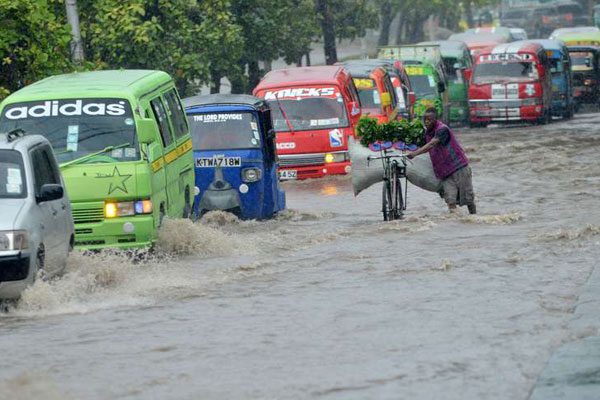
David Gikungu, the Director General of the Department, said during this period the country will experience heightened rainfall, as well as the potential for flooding and landslides in certain regions of the country.
In light of the forecast, Gikungu emphasized the importance of proactive preparations by the relevant government agencies, to mitigate possible deaths and loss of property.
“The short rains during the period will have both negative and positive impacts across various sectors hence there is a need for adequate preparations,” Gikungu said.
The Kenya Red Cross, has since initiated coordination measures to facilitate effective preparedness in anticipation of the upcoming rains.
El Niño rains represent a climatic phenomenon capable of inducing notable alterations in worldwide weather patterns, resulting in amplified rainfall within specific regions.
The elevation of sea surface temperatures in the central and eastern equatorial Pacific Ocean defines the meteorological event.
Affected regions
The regions most affected include the Lake Victoria Basin, Highlands West of the Rift Valley, and Central and South Rift Valley, encompassing Siaya, Kisumu, Homa Bay, Migori, Kisii, Nyamira, Baringo, Uasin Gishu, West Pokot, Elgeyo Marakwet, Nandi, Kericho, Bungoma, Kakamega, Busia, Trans Nzoia, Vihiga, Laikipia (Laikipia West), Nakuru, and Narok Counties.
Gikungu pointed out that rainfall in these areas will persist throughout the season, with the peak expected in October.
Meanwhile, the northwestern counties of Turkana and Samburu are anticipated to experience intermittent rainfall during the season.
Gikungu highlighted that these areas are likely to encounter unevenly distributed rainfall in October, followed by more consistent distribution in November and December.
The Highlands East of the Rift Valley Counties, including Nairobi, Nyandarua, Nyeri, Kirinyaga, Murang’a, Kiambu, Laikipia East, Meru, Embu, and Tharaka Nithi, will receive above-average rainfall.
Additionally, Kitui, Makueni, Machakos, Taita Taveta, and Kajiado Counties will also have rainfall above the long-term average for the season.
North-Eastern Counties of Mandera, Marsabit, Wajir, Garissa, and Isiolo will have similar conditions.
Furthermore, meteorologists project that the Coastal Counties of Mombasa, Tana River, Kilifi, Lamu, and Kwale will undergo rainfall amounts surpassing the long-term average for the season.
Kenya last experienced the El Niño rains between 2015 and 2016, resulting in heavy rainfall, floods, and landslides across different regions of the country.