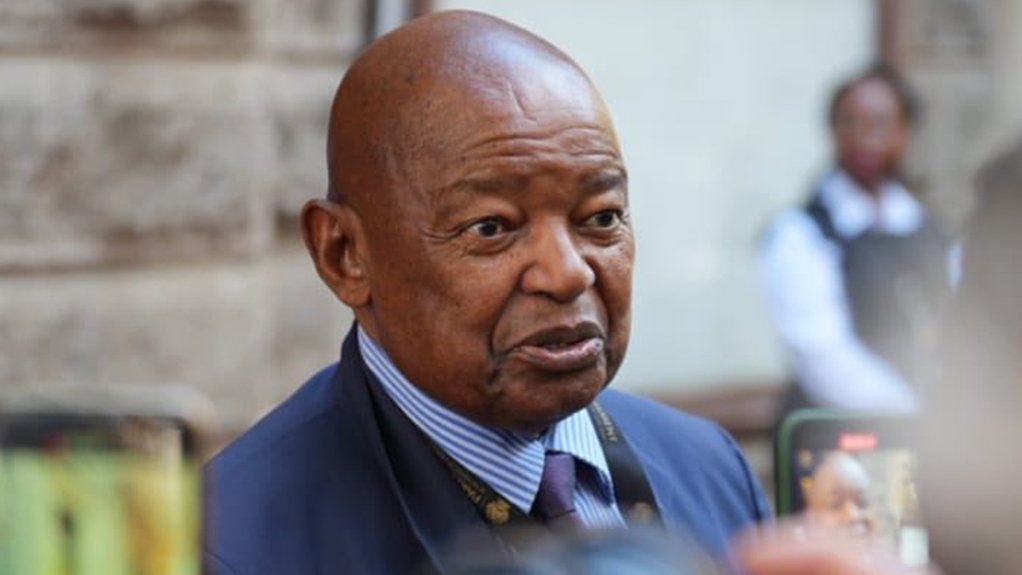
South Africa anti-apartheid activist and former defence minister Mosiuoa Lekota has died at the age of 77 after a period of illness, his party confirmed on Wednesday.
Lekota, a veteran of the liberation struggle who was imprisoned on Robben Island alongside Nelson Mandela, died in the early hours of Wednesday morning, the Congress of the People said in a statement.
President Cyril Ramaphosa paid tribute to Lekota, describing him as a “freedom fighter and a servant of the people”.
“His life was one of resilience, courage, and steadfast belief in justice,” Ramaphosa said.
Role in anti-apartheid struggle
Lekota was active in student politics during the 1970s as opposition to apartheid intensified across South Africa. His activism led to his arrest and imprisonment on Robben Island, where many leaders of the liberation movement were held.
His years in prison shaped his political outlook and solidified his role within the struggle against white minority rule. After the end of apartheid in 1994, Lekota transitioned into national leadership as South Africa entered a new democratic era.
Nicknamed “Terror” for his skill on the soccer field in his youth, Lekota was known for his firm and outspoken political style.
Following South Africa’s first democratic elections, Lekota became the first premier of the Free State province. He later served as chairperson of the African National Congress for a decade.
A close ally of former President Thabo Mbeki, Lekota was appointed defence minister in 1999 and served until 2008, making him one of the country’s longest-serving ministers in that role.
His tenure at the defence ministry spanned nearly a decade, during which South Africa continued to redefine its security institutions in the post-apartheid period.
Break from ANC and formation of COPE
Lekota’s political journey took a dramatic turn in 2008 after Mbeki was removed as president by the ANC. Disillusioned with the party’s direction and citing concerns about governance and allegations of corruption, he resigned from the ANC.
He was voted off the party’s National Executive Committee after repeatedly criticising Mbeki’s successor, Jacob Zuma.
Later in 2008, Lekota co-founded the Congress of the People, positioning it as an alternative to the ANC, which has governed South Africa since 1994.
In the 2009 national election, COPE secured roughly 7% of the vote. However, its support declined in subsequent elections, falling below 1% in later national polls.
In recent years, Lekota had stepped back from active politics due to ill health. His death marks the passing of one of South Africa’s veteran freedom fighters who bridged the liberation struggle and the country’s democratic governance.