

Pressure is mounting on the administration of William Ruto following renewed claims of financial irregularities in the education sector, with a civil society lobby now demanding urgent investigations into what it describes as ghost schools and ghost learners said to be draining public funds.
Education activist Davies Okombo has formally petitioned Ruto and Members of Parliament (MPs), calling for immediate action to address systemic weaknesses within the Ministry of Education that he says have enabled the loss of billions meant for learners.
The petition comes at a time when the education sector is grappling with a deepening funding crisis, with public schools reporting delayed capitation, rising debts, and operational disruptions affecting learning nationwide.
Speaking during a press briefing on Friday, 8 May 2026, Okombo accused senior officials in the Ministry of Education (MoE) of presiding over a broken accountability system that has allowed public funds to be siphoned through fictitious institutions and non-existent learners.
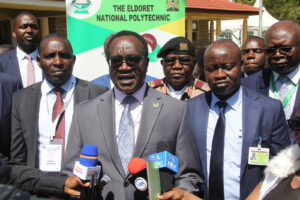
“We do not operate bank accounts. Ghost learners do not sign forms, and ghost schools do not operate bank accounts. This clearly demonstrates that there is a systematic failure at the Ministry of Education and also in schools that has led to the theft of public funds meant for the Kenyan child,” he said.
He further called for the resignation of Education Cabinet Secretary Julius Ogamba, arguing that the ministry has failed to protect resources allocated to vulnerable learners.
“We want to call upon the CS for Education to resign with immediate effect because he has let down the Kenyan child. He has no business sitting at Jogoo House when millions and billions of public funds are being stolen by his senior officers,” he added.
The claims have intensified scrutiny over the management of education funding, amid concerns that inflation of enrolment figures and weak oversight systems may be contributing to chronic underfunding in schools.
Moreover, school heads and education stakeholders have repeatedly raised alarm over delayed and insufficient capitation, with many institutions struggling to pay suppliers, maintain feeding programmes, and sustain basic operations.

Okombo also urged anti-corruption agencies, including the Ethics and Anti-Corruption Commission (EACC) and the Directorate of Criminal Investigations (DCI), to launch full-scale investigations into alleged theft of education funds and pursue asset recovery.
“We want to call upon the EACC and the DCI to launch investigations to prosecute the officials concerned with this theft so that every shilling stolen from Kenyan children can be recovered,” he said.
At the same time, the activist is pushing for structural reforms to streamline education financing. He proposed the consolidation of fragmented funding streams, including bursaries, Constituency Development Fund (CDF) allocations, and county education support, into a single national education fund.
According to Okombo, such reforms would strengthen accountability and help Kenya achieve full implementation of free secondary education under constitutional guarantees on basic education.
The petition adds new political pressure on the Kenya Kwanza administration, which has pledged to reform the education sector but continues to face criticism over funding gaps.
Recent disclosures by the State Department for Higher Education show that funding for 379,858 university and TVET students remains uncertain due to a KSh32.9 billion shortfall. Principal Secretary Beatrice Inyangala told lawmakers that available resources can only support 650,267 students out of over 1.1 million applicants, leaving hundreds of thousands unfunded.