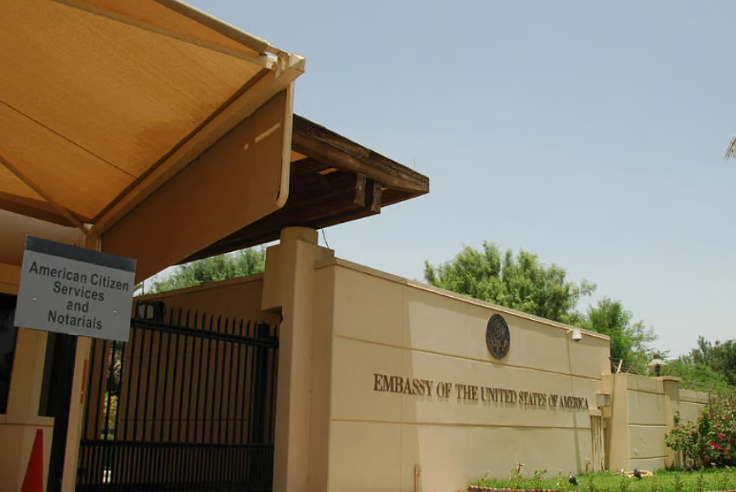
The United States has closed its embassy in Kuwait with no set date to reopen, citing what officials describe as “ongoing regional tensions.”
A post on the embassy’s official X account confirmed the shutdown, adding that all regular and emergency consular appointments had been cancelled with immediate effect.
The move came hours after Washington issued an urgent travel warning. The US State Department told its citizens in large parts of the Middle East — Kuwait among them — to depart the region immediately using commercial airlines, warning of “serious safety risks.” The advisory covered several countries now caught in the expanding shadow of conflict.
The closure follows a violent 24 hours. The US Embassy compound in Riyadh, Saudi Arabia, was struck overnight by two drones, according to the Saudi Ministry of Defence. A fire broke out inside the premises, though authorities described it as limited in scope. No casualties were immediately reported.
“The hardest hits are yet to come.”
— US Secretary of State Marco Rubio
Inside Kuwait, three US fighter aircraft were lost in what the military is calling an “apparent friendly fire incident.” The incident, which occurred on Monday, resulted in all flight crews surviving. The losses nonetheless mark a significant blow to US air operations in the region.
On the ground and in the air, the broader US-Israeli war with Iran has now entered its fourth day. Israel says it has carried out a fresh wave of “extensive airstrikes” against what it calls military targets in both Tehran and Beirut. Iranian state media, meanwhile, reported that a command-and-staff building at a US air base in Bahrain had been destroyed — a claim not independently verified at the time of publication.
Global Energy at Risk
Perhaps the most alarming development for global markets came from Tehran. An Iranian official threatened to “set fire” to any vessel attempting to pass through the Strait of Hormuz. The narrow waterway carries an estimated 20 percent of the world’s oil supply. Any sustained disruption would send shockwaves through energy markets worldwide.
US Secretary of State Marco Rubio signalled that Washington has no intention of stepping back. Speaking publicly, he warned that “the hardest hits are yet to come” from the US military targeting Iran. His remarks followed a statement from President Donald Trump, who referred to Saturday’s strikes as “the last, best chance” to neutralise what he called threats from Tehran.
In London, British Prime Minister Keir Starmer addressed parliament. He told MPs he does not support what he called “regime change from the skies.” Even so, he confirmed that Britain is permitting the United States to use UK military bases for strikes he described as “defensive” — targeting Iranian missile infrastructure.
Six American service members have died since the conflict began. Internationally, questions are mounting over where this war ends. As veteran BBC international editor Jeremy Bowen noted soberly: “It is way too soon to have any idea of when or how the war will finish.”