

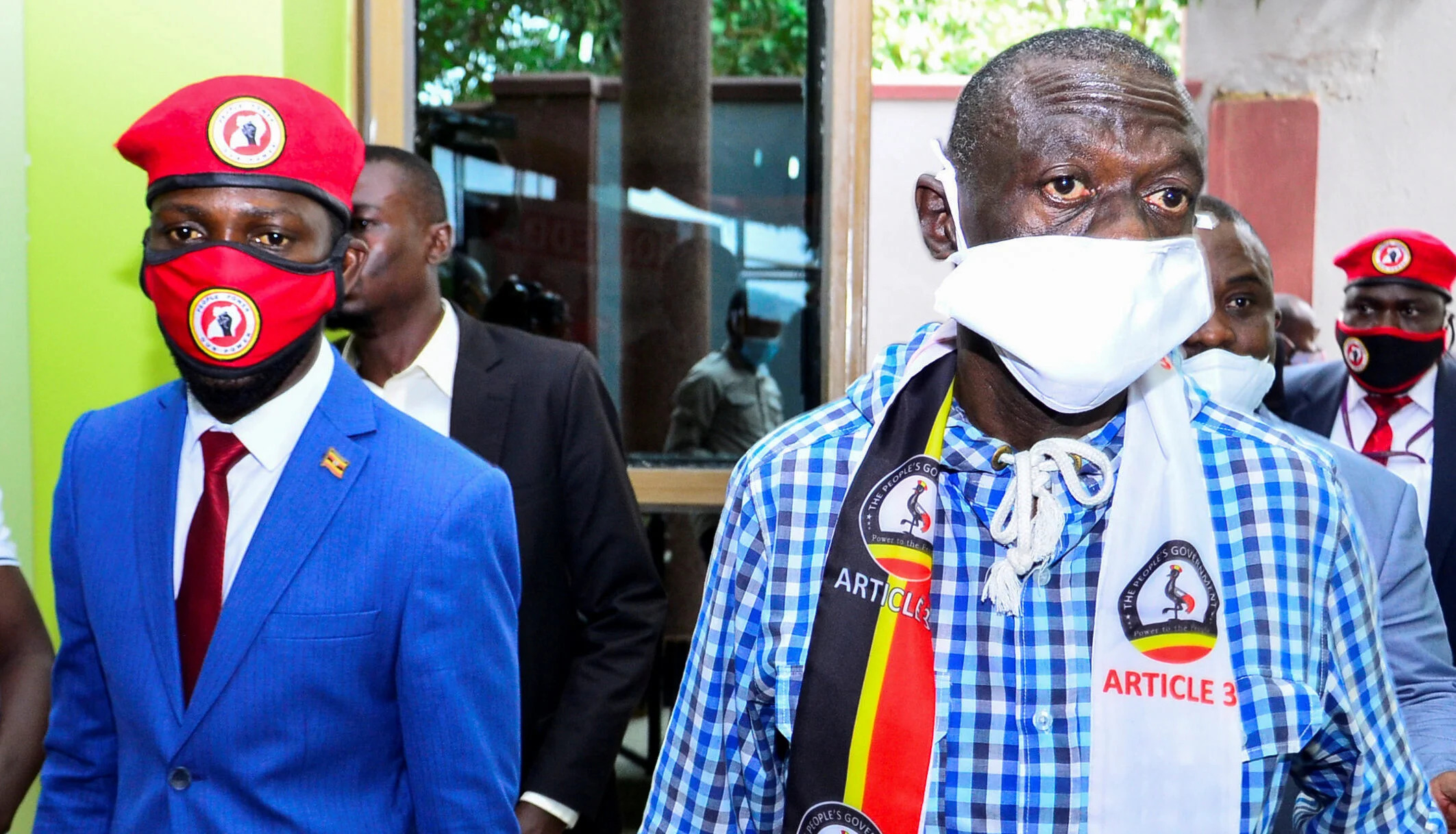
There is a well-worn political playbook in Uganda’s opposition circles; and Robert Kyagulanyi, popularly known as Bobi Wine, appears to be reading it chapter by chapter. His recent departure from Uganda, which he himself has framed as the beginning of a life in exile, tracks so closely with the path once taken by his political idol, Dr. Kizza Besigye, that seasoned observers are asking whether the National Unity Platform (NUP) supremo is rehearsing history rather than trying to rewrite it.
Political science literature has long documented the risks of what researchers call “idolization and social learning” in opposition movements, the tendency of successors to uncritically replicate the tactics of admired predecessors, even when those tactics have demonstrably failed. For Kyagulanyi, the parallels with Besigye are not incidental; they appear structural, baked into the very way he has conceived and conducted his political career.
The Exile Playbook
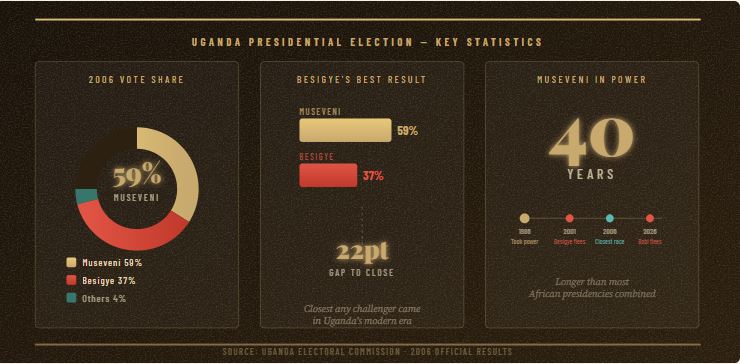
In 2001, a bruised Kizza Besigye fled to South Africa following a crushing presidential election defeat to Yoweri Museveni. He declared, with characteristic defiance, that he would return to Uganda at a time of his own choosing. When he did return in 2005, he was met with a hero’s welcome that effectively rebranded him, transforming a defeated candidate into a martyred hero. The strategic gamble paid off, at least partially: in the 2006 presidential election, Besigye reduced Museveni’s vote share to 59 percent while claiming 37 percent himself, the closest any challenger had come in the modern era of Ugandan politics.
Now Kyagulanyi has made an almost identical declaration. He has confirmed he left Uganda and says he will return at his own convenience. The symmetry is striking enough that it cannot be accidental. Like Besigye before him, he appears to be betting that distance will generate mystique, that absence will sharpen public appetite for his return, and that the exile narrative will cleanse the memory of a bruising electoral campaign whose results left many of his own supporters disillusioned.
There is a logic to this approach, and it would be wrong to dismiss it entirely. Besigye’s 2005 return is genuine evidence that the tactic can work. But what observers caution is that copying the method while ignoring the changed context is precisely how political mimicry becomes political failure. Uganda in 2026 is not Uganda in 2005. The NRM government is more entrenched, the security architecture more refined, and Museveni, now past 80, has had four additional decades to perfect his own political counter-moves.
The Museveni Variable
Both Besigye and Kyagulanyi have consistently underestimated the degree to which their favored strategy of militant, defiant activism that signals military-style resolve, actually plays directly into Museveni’s strongest suit.
Museveni’s four decades of unbroken rule are widely studied as a masterclass in political survival. His background as a guerrilla commander who fought his way to power through the Luwero Triangle bush war is not incidental to his governing style; it is central to it. He combines tactical ambiguity, sudden high-stakes maneuvers, and a deep institutional grip on the security forces in ways that career politicians rarely anticipate. When opposition figures adopt the language and posture of militancy, they enter a competition on terrain where Museveni has never lost.
“They didn’t know that they were playing into the territory where their nemesis excels most.”
A recurring critique of Uganda’s opposition strategy
The calculus for Ugandan voters, as both Besigye and Kyagulanyi appear to have reasoned it, is that showing toughness is a prerequisite for credibility. In a country where the presidency was seized by force and has been held by a former guerrilla for four decades, the theory runs, voters need to believe that a challenger is capable of matching that energy. Militant activism, in this reading, is not recklessness; it is credentialing.
But the electoral record tells a different story. Besigye contested four presidential elections (in 2001, 2006, 2011, and 2016) and lost each one. His peak performance remains 37 percent in 2006. Kyagulanyi’s 2021 campaign, for all its extraordinary street energy and international attention, similarly failed to produce a result that independent analysts regarded as convincingly competitive. The militancy has generated enormous noise and genuine popular enthusiasm, but it has not converted that enthusiasm into electoral victory.
Fractures Exile Cannot Fix
What distinguishes Kyagulanyi’s position from Besigye’s in 2001 is that his exit comes burdened with a set of unresolved internal crises that geography alone cannot dissolve. The rift between Kyagulanyi and a cluster of senior NUP figures, including former opposition leader Mathias Mpuuga, Medard Seggona, and Abed Bwanika, played out publicly and painfully in the period leading up to and following the last elections. NUP supporters, particularly in Buganda, interpreted the handling of these fallouts as evidence of a leadership failure, not merely a political disagreement.
The consequences were tangible. Buganda’s political support, which had been among Kyagulanyi’s most reliable foundations given his origins in Kamwokya and his deep cultural resonance with Baganda voters, visibly contracted in the last electoral cycle. That is not a wound that heals while a leader is abroad. If anything, distance risks allowing competing narratives about NUP’s direction , and about Kyagulanyi’s fitness to lead it , to consolidate in his absence.
There is also the harder question that many supporters were already asking before he left: did he do enough? The NUP’s campaign claimed widespread rigging, a charge that has become standard in Ugandan opposition politics and one that independent election observers have repeatedly said contains genuine merit. But supporters who risked genuine harm by publicly backing him, at rallies, at polling stations, on social media, increasingly asked whether the organizational groundwork, the coalition-building beyond the party’s comfort zone, and the strategic outreach into NRM strongholds had been sufficiently pursued. Exile, critics note, defers rather than answers that reckoning.
Kyagulanyi’s apparent calculation is that time abroad will allow the temperature to drop, that by the time he returns, presumably with the 2031 election in view, supporters will have moved past the most pointed questions. It is, again, essentially what Besigye did. And it is worth noting that it did work for Besigye in the short term. The risk is that the conditions enabling that short-term success were partly unique to that moment, and that repeating the mechanics without recreating the conditions is a bet on nostalgia rather than strategy.
Political analysts who study democratic consolidation in sub-Saharan Africa have noted that the cycle Besigye and Kyagulanyi both embody (militant opposition, exile, return, repeat) tends to benefit incumbents more than challengers over time. Each cycle allows the ruling party to portray the opposition as inherently unstable, as producing leaders who ultimately flee rather than organize. Each cycle, the opposition must rebuild its narrative from scratch, while the NRM’s institutional advantages compound.
What neither man has yet demonstrated is a capacity to build the kind of patient, coalition-based, ward-level political organization that typically underpins genuine electoral upsets in dominant-party systems. The alternative path, quieter, slower, more organizationally demanding, and far less photogenic, has not been attempted. Until it is, the risk of repeating the same cycle remains very real.
For Uganda’s democracy, the stakes are not academic. A functional opposition is not a luxury feature of democratic governance; it is its load-bearing wall. When opposition politics collapses into a recurring performance of defiance and exile rather than a sustained project of political organization and coalition-building, it is the democratic process itself that loses credibility. Both Besigye and Kyagulanyi have shown that Ugandans hunger for change. What remains unproven is whether either man, or the movements they lead, has the strategic patience to deliver it.