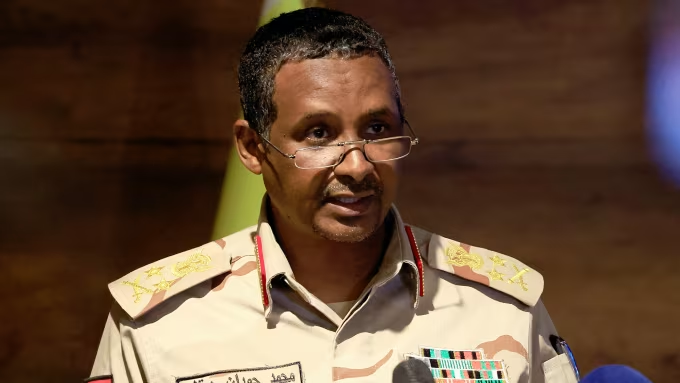
UN investigators say he was physically present at the Sudanese army’s sixth Infantry Division base during the assault. Footage reviewed by the committee reportedly shows him ordering fighters not to take prisoners but to kill.
What followed at el Fasher was described by the UN as a cascade of atrocities. Civilians were killed en masse at El Fasher University and the Saudi Hospital. Zaghawa people and other non-Arab communities were targeted in ethnically motivated executions.
The UN also documented widespread sexual violence, including gang rape committed in front of family members. Medical staff were abducted for ransom. Four doctors, a pharmacist and a nurse were reportedly taken, with demands exceeding USD150,000.
Around 70,000 people were displaced, many remain unaccounted for.
The Nairobi meeting that will not go away
The sanctions have reignited scrutiny over a meeting held at the government-owned Kenya International Conference Centre in Nairobi in February last year. Rahim was the most senior RSF figure present.
At that gathering, RSF leaders and their political allies announced plans to form a parallel administration for Sudan. The announcement deepened the already fragile relationship between Nairobi and Khartoum’s military leadership.
Sudan’s military, the Sudan Armed Forces, formally accused Kenya of hosting RSF commanders and facilitating their political activities on foreign soil. Kenya rejected those claims. But the controversy grew when Sky News aired an interview with Abdul Dagalo recorded in Nairobi, giving weight to the military’s assertions.
The Sudan war erupted in April 2023, pitting the RSF against the Sudanese army. The fighting has been most devastating in Darfur, where ethnic fault lines and armed mobilisation have fuelled repeated waves of mass violence.
A Kenyan passport for a sanctioned RSF commander

Kenya’s exposure does not end with the Nairobi meeting. Earlier sanctions announcements revealed that Algoney Dagalo another younger brother of RSF chief Mohamed Dagalo and himself a commander in the RSF — holds a Kenyan passport.
That disclosure drew sharp condemnation from Wiper party leader Kalonzo Musyoka, a former foreign minister in the Moi administration.
— Kalonzo Musyoka, Wiper party leader
Kalonzo added that Kenya has already paid an economic price for its perceived closeness to the RSF. He said the country has lost a meaningful share of the Sudanese tea market as a result.
“The Ruto government is issuing passports to militia leaders from Sudan and thus jeopardising relationships with friendly countries,” he said. “It’s tragic that individuals sanctioned by the US Treasury are using our passport.”
Under the Darfur sanctions regime, listed individuals face travel bans and asset freezes designed to limit their ability to move money and operate across borders.
Kenya’s balancing act under pressure
Nairobi has long positioned itself as a neutral facilitator of regional peace processes. It has hosted talks on South Sudan, Somalia and the broader Horn of Africa. But the presence of RSF figures on Kenyan soil and the apparent issuance of documentation to at least one of them has complicated that image.
Analysts argue the latest UN action signals that the international community is shifting focus toward individual accountability. Commanders who direct attacks on civilians are increasingly being named, sanctioned and isolated.
Rahim’s designation matters not only for his role in Darfur’s worst violence. It matters because he was in Nairobi. That detail has not been forgotten.
Beyond the diplomacy, the scale of suffering in Sudan is staggering. According to the International Rescue Committee, the war has displaced over 12 million people. Thirty-three point seven million people are in need of humanitarian support.
More than 150,000 people have been killed, with civilians bearing the brunt of indiscriminate attacks, the IRC said in its update published on 10 February.
“With over 30 million people in need of humanitarian aid, Sudan accounts for a shocking 10% of global needs,” the organisation warned.
Aid agencies say large parts of Darfur remain inaccessible. Civilians continue to face violence, displacement and the collapse of basic services. The window for intervention is narrowing.
For Kenya, the question now is whether its diplomatic standing can absorb the continued pressure or whether Nairobi will be forced to make clearer choices about its role in one of the world’s most overlooked catastrophes.