Kenya’s doping dilemma: The smoke, the fire, and the Rosa connection
 October 30, 2025
5 min read
October 30, 2025
5 min read
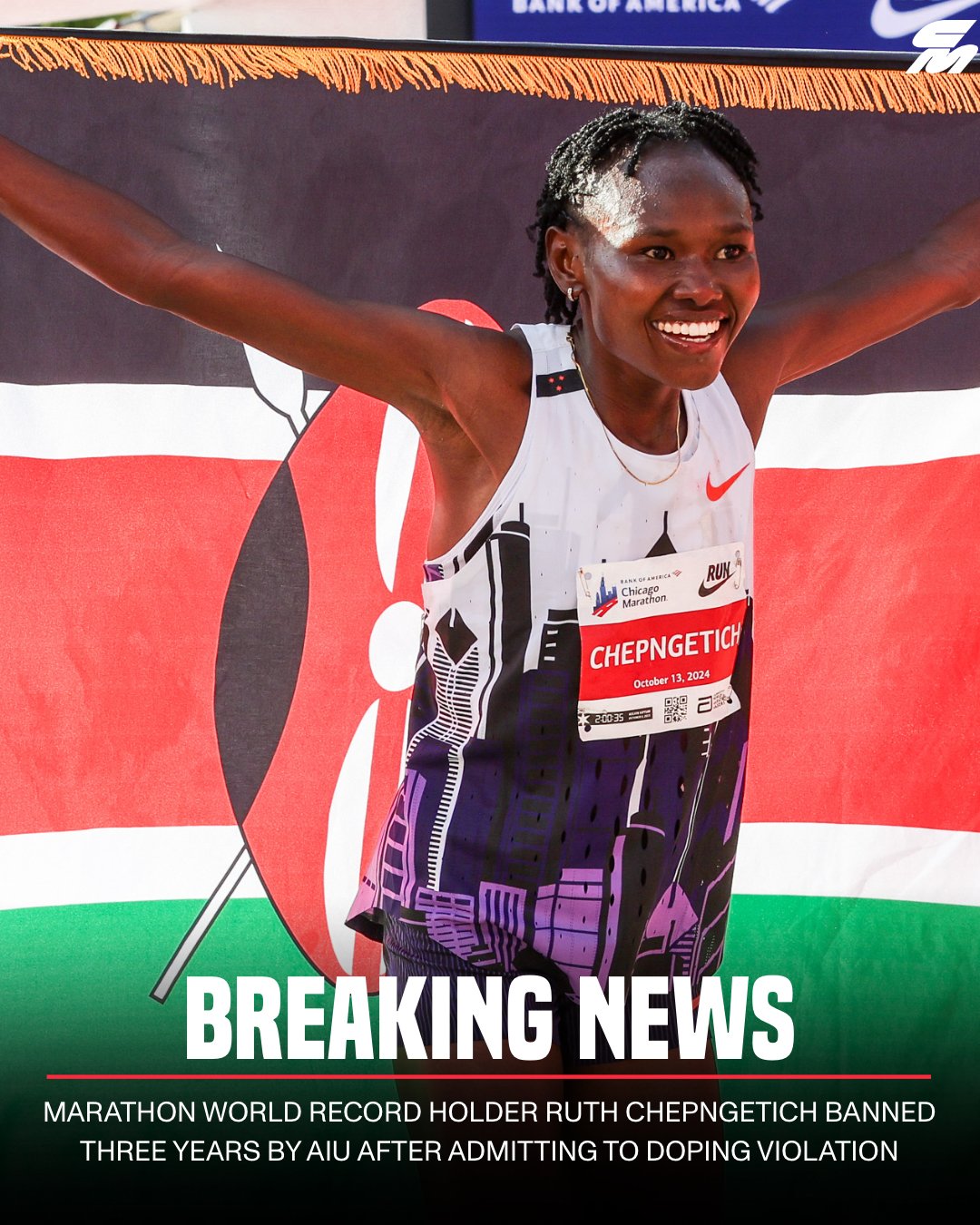
Women's Marathon world record holder Ruth Chepngetich/ Photo Courtesy Chris Chavez (X)
There is a French proverb that says, “Aucun feu n’est sans fumée, ni fumée sans feu.” In English, it is more familiar as, “Where there is smoke, there is fire.”
Speaking of smoke, Kenya has a very hot problem. Over the past decade, nearly 400 Kenyan athletes have been suspended for doping-related offences. In 2025 alone, the Athletics Integrity Unit (AIU) has banned 19 athletes and provisionally suspended six others, including women’s marathon world record holder Ruth Chepngetich.
Some athletes test positive during competitions, others in out-of-competition tests. A few are banned for missing three tests within 12 months, or for abnormal blood values flagged in their Athlete Biological Passport (ABP).
A global menace — But Kenya feels the heat
Kenya is not alone in the fight against doping. Other countries have recorded more positive tests, yet none attract the same global scrutiny. The reason is simple: Kenya produces champions.
Russia, for instance, was found guilty of state-sponsored doping and has been largely sidelined from global athletics since 2012. India has more athletes suspended than Kenya, but across many sports.
Kenya, by contrast, is a specialist nation — dominant in middle- and long-distance running. But unlike Russia, Kenya’s doping problem is not state-orchestrated. Instead, it stems from poverty and desperation in a country where athletics is seen as a ticket out of hardship.
For many athletes, a $5,000 (KSh 600,000) win equals a year’s pay or more. A $100,000 (KSh 12.9 million) victory is a life-changing jackpot. In such an environment, the temptation to cheat is high — and the means are easily accessible.
Easy access and complicit networks
It is alleged that acquiring banned performance-enhancing drugs (PEDs) in Kenya is relatively easy. German journalist Hajo Seppelt once went undercover in Nairobi and managed to purchase PEDs over the counter, all caught on hidden camera.
The problem is a perfect storm: poverty, easy access to PEDs, unscrupulous agents, complicit coaches and medical personnel, and race organizers eager to sign Kenyan names to attract attention.
Among those whose names keep resurfacing is Federico Rosa, an Italian agent repeatedly linked to athletes who test positive or achieve unbelievable performances. While no court has proven him complicit, the saying remains true — where there is smoke, there may be fire.
The Rosa & Associati connection
Federico Rosa and his father Gabriele Rosa run Rosa & Associati, a global sports agency managing a vast stable of African athletes. Several of their clients have tested positive over the years.
In 2016, Kenyan police detained and investigated Federico Rosa following a string of doping scandals involving his athletes. He had represented Rita Jeptoo, the former Boston and Chicago Marathon champion, who tested positive for EPO in 2014. Jeptoo’s victories were later nullified.
During that probe, Magistrate Bernard Ochoi ordered Rosa held in custody for three days to allow police investigations. Although he was never charged, the cloud of suspicion never fully lifted.
Jeptoo’s case was not isolated. Mathew Kisorio and Agatha Jeruto, both under Rosa’s management, were also banned. In 2015, Athletics Kenya suspended Rosa & Associati for six months to investigate doping allegations among its over 30 elite athletes.
Why doping persists
Documents from the AIU and Anti-Doping Agency of Kenya (ADAK) point to several overlapping causes — financial incentives, social pressure, and weak testing systems.
Road running is the most lucrative segment in athletics, with hundreds of millions of dollars in prize money and appearance fees up for grabs. For runners from humble backgrounds supporting extended families, the rewards are irresistible.
Top marathoners race only two or three times a year, meaning the pool of professionals competing for limited financial opportunities is massive. The pressure to perform is immense. A 100th-ranked marathoner can still earn decent money, but the 100th-ranked 800m runner earns next to nothing.
While elite runners are subject to strict AIU testing, hundreds of lower-tier athletes are barely monitored due to ADAK’s limited funding. This creates a dangerous imbalance — a fertile breeding ground for doping among those desperate to climb the ranks.
Kenya’s doping network is not centralized, but it has become increasingly sophisticated. From street-level drug dealers to organized groups offering advanced evasion methods, a black market thrives to meet demand.
Rosa & Associati — A familiar name in the scandal
Rosa & Associati’s list of disgraced athletes is long and troubling.
- Jemima Sumgong, 2016 Olympic marathon champion, tested positive for EPO in 2017 and later received an eight-year ban for tampering with the anti-doping process.
- Asbel Kiprop, the 2008 Olympic 1500m champion, tested positive for EPO and served a four-year ban from 2018 to 2022.
- Lawrence Cherono, winner of the 2019 Boston and Chicago Marathons, was banned for seven years in 2024 after testing positive for trimetazidine and tampering with evidence.
- Sarah Chepchirchir, the 2017 Tokyo Marathon champion, received a four-year ban for anomalies in her Athlete Biological Passport and later tested positive for testosterone upon her return.
- Faith Chepkoech, with a 10,000m personal best of 30:22.77, was banned for three years in 2024 after testing positive for EPO.
The latest and most shocking case is that of Ruth Chepngetich, the women’s marathon world record holder (2:09:56 at the 2024 Chicago Marathon), who has been provisionally suspended.
But the agency’s shadow extends beyond Kenya. Thiago Braz of Brazil, the 2016 Olympic pole vault champion, was banned for 16 months in 2024 after testing positive for Ostarine glucuronide. Nijel Amos of Botswana, an Olympic silver medallist, was banned for three years after testing positive for GW1516 metabolites, while Ukraine’s Maryna Bekh-Romanchuk received a four-year ban for testosterone metabolites.
A crisis demanding accountability
The question remains: Who could be next?
Kenya’s doping crisis is not just about individual choices — it’s about a system that enables, overlooks, and sometimes profits from cheating. Until agents, coaches, and administrators are held accountable with the same rigor as athletes, the cycle will continue.
Where there is smoke, there may indeed be fire. And in Kenya’s athletics scene, the smoke has long been too thick to ignore.

Related Articles