Syria commemorates 15 years since anti-Assad revolt
 March 15, 2026
5 min read
March 15, 2026
5 min read
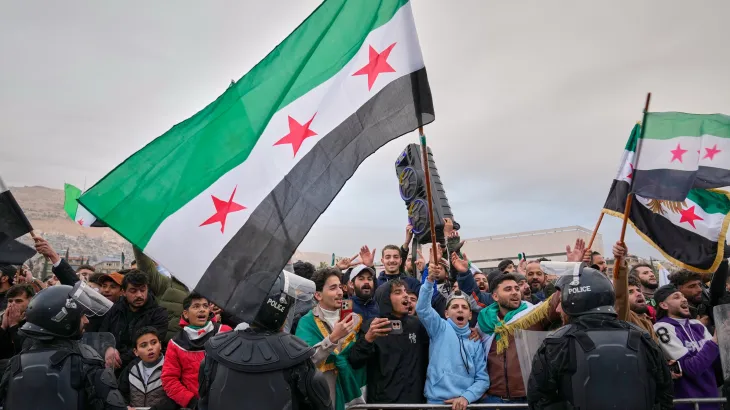
Syrians marks 15 years since anti-Assad protests. Photo credit: Reuters
Syrians across the country are marking the 15th anniversary of the peaceful protests that launched their uprising against Bashar al-Assad, an Arab Spring-inspired revolt that ultimately ended more than five decades of family rule after a lightning offensive toppled the president in late 2024.
On Sunday, gatherings and reflections are planned as the nation — still healing from a conflict that killed hundreds of thousands and displaced millions — honors the March 15, 2011, spark while confronting ongoing security challenges under its new leadership.
The first antigovernment demonstrations erupted in the southwestern city of Deraa, spreading quickly to Damascus and Aleppo. Many were triggered by the arrest and reported torture of teenage boys who had painted anti-Assad graffiti on a school wall.
Inspired by successful uprisings in Tunisia and Egypt, protesters initially called for democratic reforms, the release of political prisoners and an end to corruption. Assad’s security forces responded with lethal force, turning peaceful rallies into a broader revolt.
By July 2011, army defectors had formed the Free Syrian Army. The conflict escalated as jihadist groups, regional powers and international actors became involved, plunging Syria into a devastating civil war.
For many Syrians, the anniversary stirs mixed emotions of pride and sorrow. “Our lives have taken such a long and winding trajectory since the start of the revolution,” said Alhakam Shaar, an Aleppo native now living in Germany, in comments echoed across media. “We owe it to ourselves to remember the Syria we inherited, our aspirations and the price we paid.”
Fall of Assad and rise of new leadership
The uprising’s long arc reached a dramatic turning point in December 2024. A swift offensive by Hayat Tahrir al-Sham, or HTS — a group that later disbanded — forced Assad to flee to Russia. Ahmed al-Sharaa, HTS’s former leader, now serves as Syria’s transitional president and is steering efforts to rebuild the shattered state, including its security apparatus.
Last year, Damascus streets filled with roses as Syrians celebrated the first anniversary of life without Assad. This year’s events coincide with the Muslim holy month of Ramadan. Authorities have organized a large iftar meal in Qatana, south of Damascus, for families of those killed, alongside a gathering of young revolutionaries and activists in the Barzeh neighborhood.
“God willing, we will celebrate,” Bassem Hlyhl, an employee at the Ministry of Information, told reporters.
Al-Sharaa has moved quickly to gain international legitimacy. He has built ties with regional countries and the United States under President Donald Trump, achieving a level of acceptance no previous Syrian leader matched, analysts say.
Yet major obstacles persist, including lingering international sanctions and the immense task of reconstruction.
Fragile security in a post-Assad Syria
While many Syrians say they no longer fear arbitrary arrest or torture by Assad’s forces, security remains tenuous in parts of the country.
“For me, it is safer by daylight,” said Ahmad Khallak, a resident from Idlib province. “There are still a lot of weapons with unknown people or assailants.”
Petty crime and occasional clashes continue. Remnants of the Islamic State group, or ISIL, pose a persistent threat in some areas, and the government has worked to assert control over the coast and southern regions such as Suwayda.
In March 2025, violence flared along the coast, resulting in significant casualties, including among minority communities. Efforts to extend authority to the northeast involved negotiations — and at times fighting — with the Kurdish-led Syrian Democratic Forces, or SDF, which had controlled large swaths of territory. A January 2026 offensive allowed government forces to retake key areas, followed by integration talks.
The murder of a couple in Homs in November threatened sectarian violence, but authorities and local leaders intervened to ease tensions.
Observers note progress in professionalizing security responses. “In some areas, such as Homs, where local tensions remain high, government forces’ professional responses to security incidents have prevented new cycles of escalation,” wrote Julien Barnes-Dacey in a report for the European Council on Foreign Relations.
Communal relations show cautious improvement after the March 2025 violence that killed more than 1,400 Alawites, though minority groups still express deep concerns about their future in the new Syria.
Syria’s security forces have rapidly recruited thousands of new members, but analysts say more are needed to secure peripheral regions as effectively as central areas like Damascus.
A nation reflects and rebuilds
Fifteen years on, the uprising that began with teenage graffiti and calls for dignity has transformed Syria. The Assad dynasty that ruled since 1970 is gone, replaced by a transitional government focused on unity, reconstruction and reintegration.
Many Syrians express pride in having ended authoritarian rule, even as they grapple with the war’s immense human cost and the work still ahead.
As celebrations unfold during Ramadan, the anniversary serves as both remembrance and a reminder of unfinished aspirations — for security, prosperity and a state that reflects the diverse hopes of all its people.
AGENCIES

Related Articles