
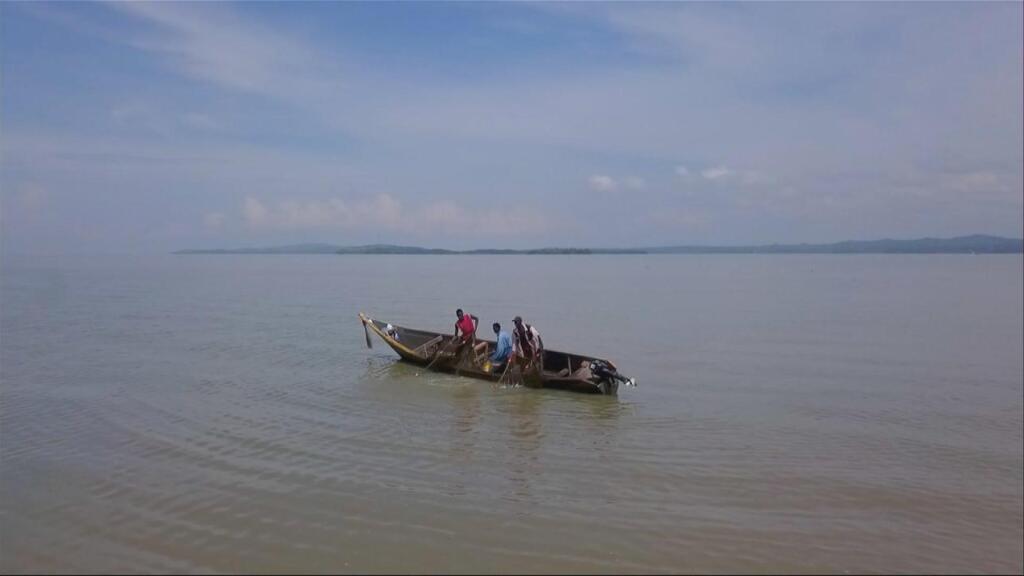
Stand on the shores of Kisumu on any given morning and the lake does not greet you — it confronts you. What was once open, gleaming water is now a creeping mat of purple-flowered water hyacinth, thick enough in places to walk across. This is not a metaphor. Lake Victoria, the world’s largest tropical freshwater lake and Africa’s most critical inland water body, is suffocating. And Kenya, one of its three custodian nations, has spent years watching it happen.
The numbers are not in dispute. Water hyacinth — the fast-growing invasive plant Eichhornia crassipes — is believed to have entered Lake Victoria from Rwanda via the Kagera River in the 1980s. In the three decades since, it has exploited a lake already weakened by unchecked sewage discharge, agricultural runoff, and industrial waste to become one of Africa’s most stubborn ecological nightmares. The weed doubles its mass every five to 15 days under favorable conditions, and Lake Victoria’s nutrient-polluted waters could hardly be more favorable.
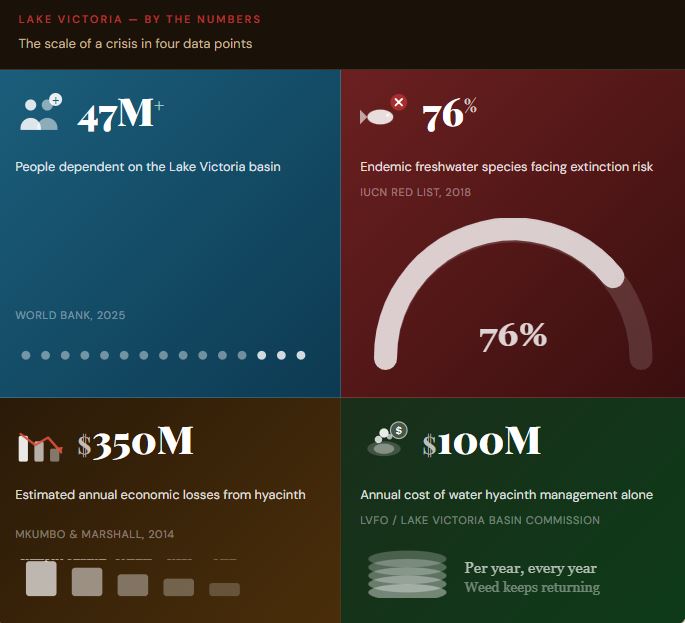
The economic cost is staggering. Research published in peer-reviewed literature estimates that water hyacinth alone costs the Lake Victoria region approximately $350 million annually in lost transportation and fisheries revenue. Clogged shipping lanes, destroyed fishing nets, disabled boat engines, oxygen-depleted dead zones — each is a direct byproduct of a weed that thrives wherever sewage and agricultural runoff flow unchecked into the water.
A Lake Being Poisoned From Every Direction
Water hyacinth is the visible crisis. But it is only a symptom of something far more insidious. A 2024 World Bank-backed report on Lake Victoria found that water quality in the lake has been deteriorating for four decades, driven by unchecked discharge of human and industrial waste, compounded by unsustainable land use and the accelerating effects of climate change. A significant share of the more than 47 million people who depend on the Lake Victoria Basin lack access to improved sanitation — their waste flowing, one way or another, into the same water that millions drink and fish from.
Mining operations along the Kenyan shores are releasing mercury directly into the lake. A comprehensive review spanning 25 years of research, published in Science of the Total Environment, found mercury to be the dominant pollutant of concern across the Kenyan, Tanzanian, and Ugandan waters — with concentrations in some species exceeding international safety limits by extraordinary margins. Organochlorine pesticides, polychlorinated biphenyls, endosulfan, and microplastics have all been detected in fish tissue. In a lake that is the primary protein source for tens of millions of people, that is not an environmental footnote. That is a public health emergency.
— Prof. Anyang’ Nyong’o, Governor of Kisumu County
The invasive weed’s dense surface mats block sunlight from penetrating the water, disrupting phytoplankton productivity and sending dissolved oxygen plummeting. When water temperatures rise — as they increasingly do under climate change — the decomposition of algae and hyacinth biomass at the lake bottom consumes what little oxygen remains. Fish farmers in Kenya’s section of the lake have reported catastrophic die-offs, with cage farmers losing an estimated one billion Kenyan shillings’ worth of fish between 2024 and 2025 alone during low-oxygen events. KMFRI, the Kenya Marine and Fisheries Research Institute, issued emergency advisories urging farmers to suspend feeding, relocate cages, and harvest fish prematurely — the equivalent of telling people to bail out a sinking ship with a cup.
Three Million Livelihoods on the Edge
More than 700,000 people in Kenya depend directly on fishing as a source of livelihood, with the lake’s fisheries sector supporting the broader livelihoods of millions more through trade, processing, and transport. Lake Victoria’s inland fisheries produced approximately 86,394 metric tonnes of fish worth KShs. 8.7 billion in 2022 — but that figure masks a trend line pointing sharply downward. A 2018 IUCN report found that 76% of the lake’s endemic freshwater species — including fish, molluscs, and invertebrates — currently face the threat of extinction. More than 12 species have already disappeared from Kenya’s waters. The ones that remain — particularly the resilient but ecologically disruptive Nile perch — are being stripped from the lake faster than they can reproduce.
The social wreckage is already visible. In fishing communities across Homa Bay and Siaya counties, declining catches are pushing fishermen toward the Gulf states for domestic work — a painful migration away from a lake that sustained their parents and grandparents. Women fish sellers who cannot afford to migrate are being subjected to exploitative practices that thrive wherever economic desperation meets scarcity. Environmental advocates working in Kisumu have documented how fish scarcity has directly fueled what is locally known as the “Jaboya” system — the trading of sex for fish access — a humanitarian consequence of an ecological crisis that rarely appears in ministerial briefings.
Kenya’s Reactive Governance Is Not Enough
To be fair, Kenya is not doing nothing. The national government enacted the Climate Change Act in 2016, banned single-use plastics in protected areas, and has partnered with development finance institutions — including the European Investment Bank and Agence Française de Développement — on water and sanitation improvements in Kisumu. International partners have invested heavily: AFD alone has committed €950 million across Kenya, Uganda, and Tanzania’s water and sanitation sectors over the past decade. A 2019 investigative exposé by Nation Media Group journalists compelled NEMA to shut down nearly a dozen polluting Kenyan companies and place hundreds more on compliance watch.
But reactive governance — acting after scandal, suspending fish cage permits without addressing root causes of pollution, forming task teams after investigative journalists have already documented the damage — is not leadership. Greenpeace Africa has noted that Kenya’s government has remained focused on promoting the blue economy through Kisumu Port while doing precious little to protect the very resource upon which any blue economy depends. You cannot monetize a dead lake.
At the regional level, the Lake Victoria Basin Commission reaffirmed its commitments at the 11th Joint Regional Policy Steering Committee meeting in Kisumu, where Kenyan officials specifically warned of the existential threat posed by escalating pollution while calling for increased national funding amid dwindling external support. That warning was honest. But warnings without binding timelines, without adequately funded enforcement arms, and without genuine accountability for industrial polluters are just words uttered into the humid air over a dying lake.
Sentinel-1 satellite radar can now pinpoint water hyacinth location with 98% accuracy — a remarkable technological achievement. Kenya’s environmental regulators, however, still lack the consistent political will and budget allocation to act decisively on what the satellites reveal. That gap between knowledge and action is where Lake Victoria is being lost.
The lake does not have the luxury of waiting for the next electoral cycle, the next donor conference, or the next investigative exposé. The hyacinth is doubling. The oxygen is dropping. The fish are disappearing. And somewhere on the shores of Kisumu, a fisherman who learned to read the water from his father is returning home empty-handed — not because the lake is ungenerous, but because we have made it incapable of giving.
Kenya must treat Lake Victoria not as a resource to be extracted, but as infrastructure to be protected. That means mandatory tertiary sewage treatment for all lakeside municipalities, strict and enforced industrial discharge standards, dedicated national budget lines for hyacinth management, and honest public accounting of how much of the lake has already been lost. Anything less is not a policy. It is an epitaph in the making.