
Fresh details have emerged that the National Land Commission approved KSh731.6 million-compensation to Grassy Limited for land acquired by the National Social Security Fund, despite the 0.7-acre parcel having a history which shows it was public land.
This is part of KSh7,567,865,100 the commission approved at a meeting held on 16 October 2025 for payment to enable government entities to undertake different projects in the country. The projects include the Nyali-Mtwapa Road project, the Colacola-Mpuri-Kithaku-Katheri and Kithurune-Kariene-Kaguma-Giaki Roads and the Karimenu II Dam Water Supply projects, among others.
In this series, Kurunzi News exposes the systemic design through which the land compensation framework has been deliberately weakened to become a channel for mega-corruption that costs taxpayers billions of monies.
We delve deep into how NLC officials are involved in violation of the law and laid-down procedures to enable fraudulent compensation through overvaluation of land, manipulating timelines and illegally paying for public land, among other means.
CS Mutua letter
Labor Cabinet Secretary Alfred Mutua initiated the request for compulsory acquisition via a letter to then NLC chairman Gershom Otachi, dated 7 May 2025, meaning this compensation process took just under six months from start to finish, which is a big departure from the average timeline this takes.
It is particularly questionable for two reasons – questions about whether the parcel is public or private and, secondly, it happened so fast during the sunset days of the Otachi-led commission.
Before getting into the details of possible fraud, Kurunzi News begins with the chronology of the process from when it was initiated to when payment was approved.
In his letter, Mutua had said the request was “made public interest to facilitate critical operational requirements for the headquarters of the National Social Security Fund which hosts […] government ministries, several state departments and agencies”.
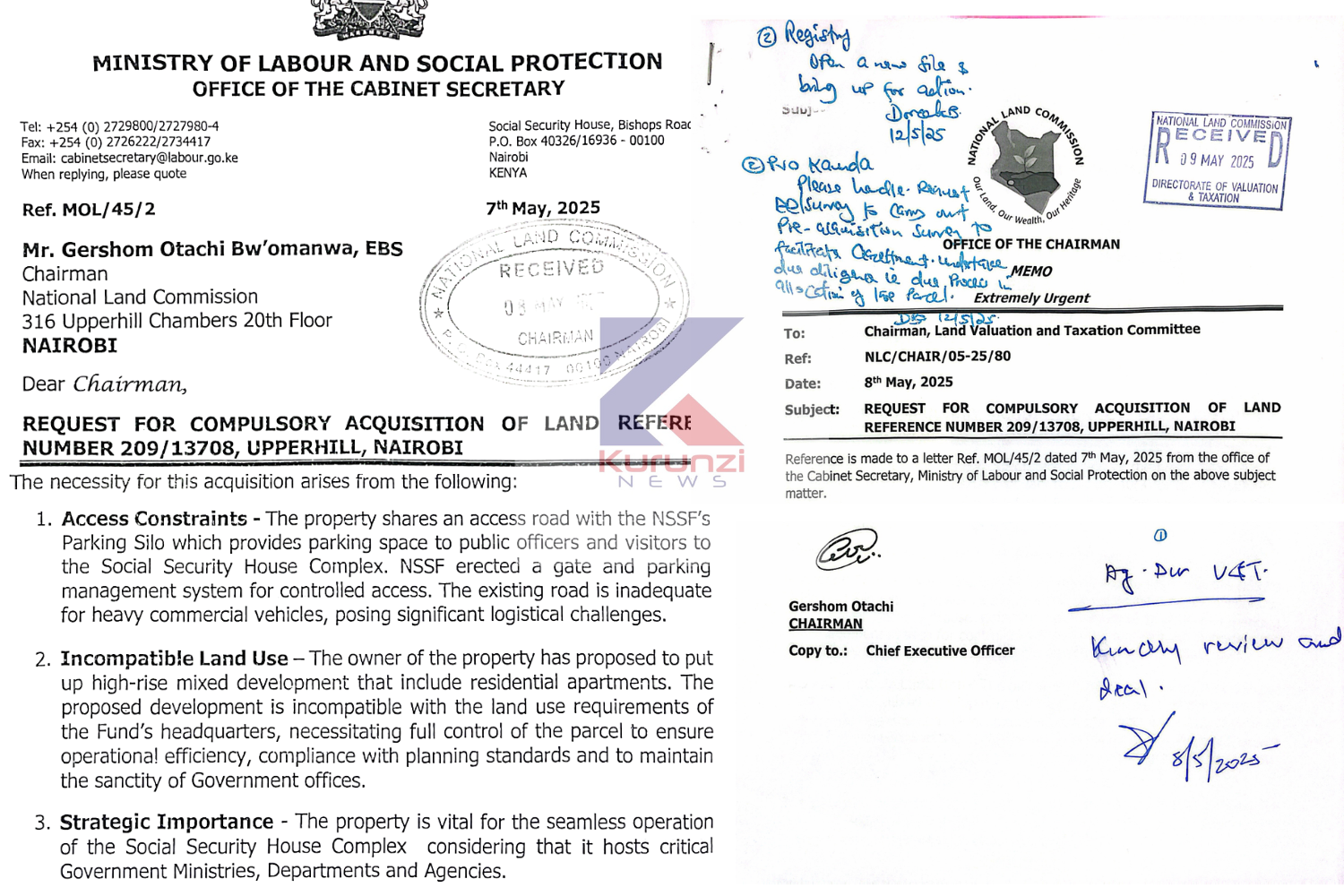
The CS explained that the NSSF had resorted to compulsory acquisition after willing-buyer-willing-seller negotiations had collapsed. The NSSF, Mutua said, needed the land to overcome access constraints, avert incompatible use by “the property owner” and for “strategic importance”.
“The Ministry of Labor and Social Protection and NSSF are committed to supporting the Commission throughout this process to ensure compliance with the law and expediency,” Mutua said in the letter, enclosing the valuation report from the Ministry of Lands, copy title and the survey plan.
“Should you require further information or clarification, kindly contact the Managing Trustee of NSSF who is copied herein.”
“Extremely urgent” memo
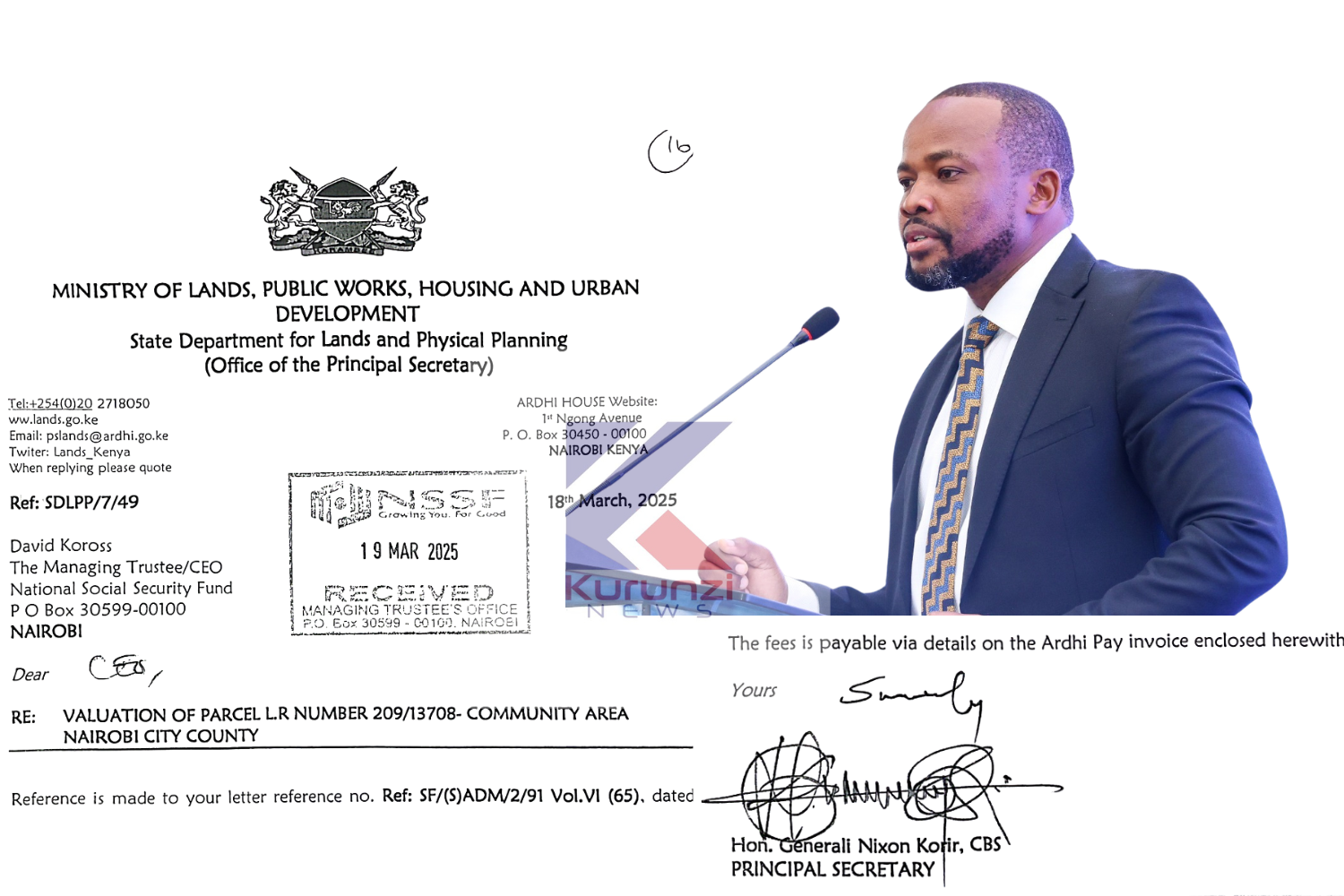
Ministry of Lands valuation report is accompanied by a covering letter by Principal Secretary Nixon Korir, dated 18 March 2025, reference number SDLPP/7/49, attaching a valuation fees invoice (invoice number WA3H4XKS26) of KSh781,250, payable through ArdhiSasa.
On 8 May 2025, just a day after CS Mutua’s letter NLC chairman Otachi dispatched an “extremely urgent” memo to the chairman of the land valuation and taxation committee, at the time – Alister Murimi, succeeded by Joel Ombati Nyamweya, who joined the NLC threee months later – in August 2025.
“Reference is made to a letter Ref. MOL/45/2 dated 7th May 2025 from the office of the Cabinet Secretary of Labor and Social Protection on the above subject matter,” reads Otachi’s letter under the subject “Request for compulsory acquisition of land reference number 209/13708, Upperhill Nairobi”.
“Kindly urgently attend to this matter and commence the acquisition process as per Section 107 (2) of the Land Act.”
Swift action followed thereafter, something that raises eyebrows in the sense that the urgency alluded to by Otachi does not present at face value, especially since this transaction involved land whose ownership was the subject of a complex legal question.
That coupled with the fact that the commissioners were making this critical decision at a time their positions were the subject of vacancy advertisements raises more questions than answers.
Transition from public to private
On 13 May 2025, the NLC made the initial due diligence request to the Ministry of Lands, followed by Gazette Notice No. 7234 (Intention to Acquire) of 30 May 2025 and a joint inspection for valuation on 27 June 2025.
The inspection was conducted by Peter Kaunda for the NLC and witnessed by Grassy Limited’s legal representative Ibrahim Adan.
Corrigenda and inquiry Gazette Notices were published on 18 July 2025, a public inquiry conducted on 6 August 2025, followed by a further due diligence request to the Ministry of Lands clarify transition from public to private land vide a letter dated 10 September 2025.
On 23 September 2025, the NLC valuation and taxation committee presented its final report, which contained the certificate of value at KSh750 million per acre. This means that the 0.7 acres translated to KSh520 million.
A statutory addition of 15% took the amount to KSh598 million, with a further KSh133.6 million being recommended for developments to take the total to KSh731.6 million.
The commission adopted the recommendations of the report at its 185th meeting of 16 October 2025.
“During the meeting, the following resolutions were made and require your action,” CEO Kabale Tache Arero wrote in an internal memo to valuation and taxation director Joel Ombati Nyamweya, listing the projects approved and the respective compensation amounts totaling KSh7.6 billion.
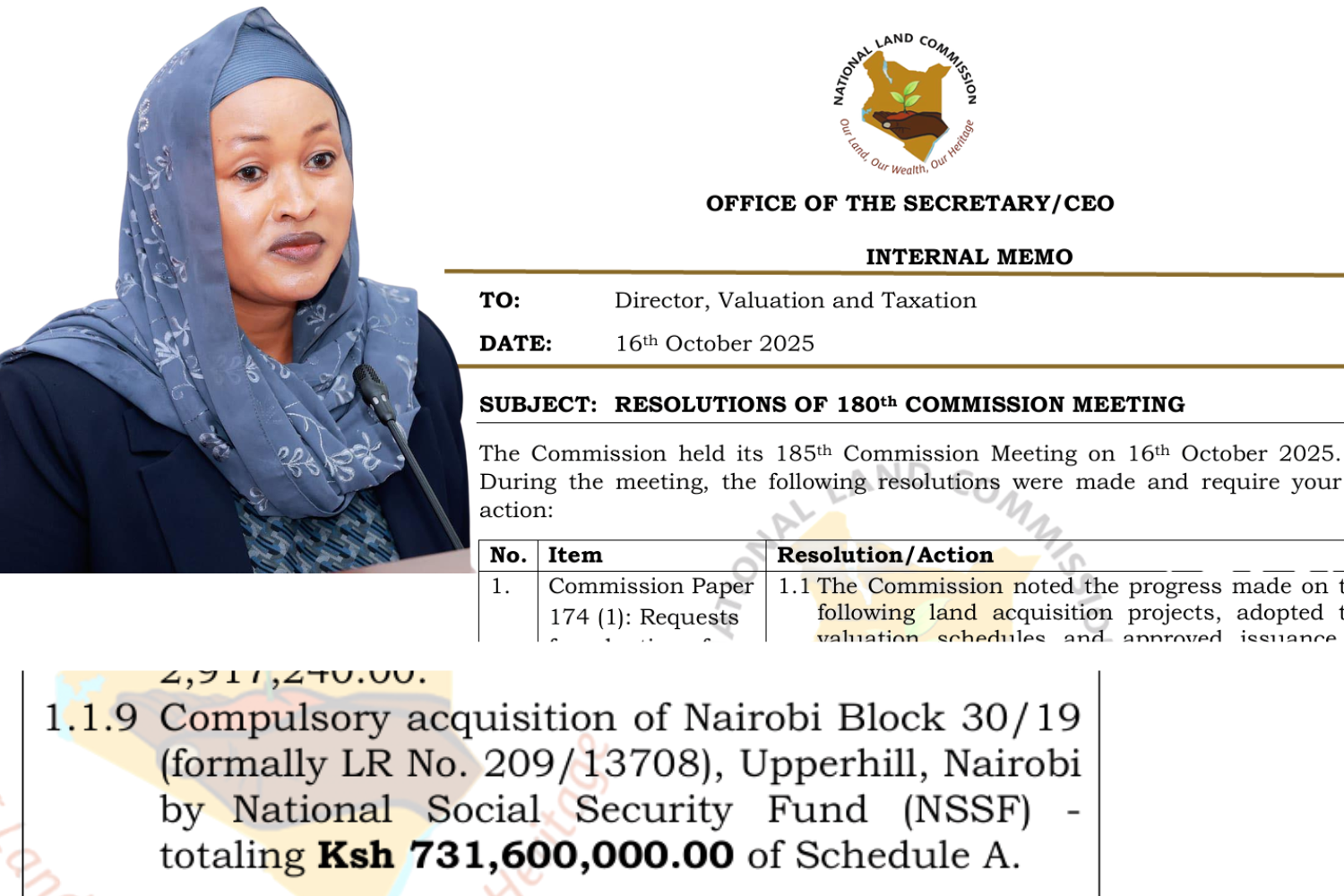
Documents available show that the land was public land “reserved for national institutions” but which was alienated to private in June 1998.
Curiously, the commission concluded that the land was private despite unresolved questions about how the land switched from public to private property and its own report “noting the key need for further due diligence”.
A valuation report by the commission’s director of valuation and taxation Joel Ombati Nyamweya had flagged several questions about the alienation but still went ahead to recommend “the payee as Grassy Limited”.
In the report dated 23 September 2025, Nyamweya, who is the director for valuation and taxation, recommended the KSh731 million award as compensation including KSh133.6 million “cost of developments even when his own report stating, “the property was bereft of any structural developments”.
“However, substantial ground excavation works had been made on the property in perceived readiness for approved proposed developments,” notes Nyamweya in his report.
“Do take note that the above sums exclude the expenses claimed to have been incurred as per the schedule titled.”
Questionable rates, expenses
According to the schedule, Grassy Limited claims to have spent KSh.110,980,100, which could take the final figure to KSh842 million if the claims are to be made and approved.
The purported expenses include approval for building plans (KSh700,000), construction permits (KSh15,810,100), sewer rerouting (KSh27.5 million) and excavation works (KSh67.5 million). Other costs are related to county authorities’ permits to “transport soil from construction site” which amount to KSh100,000.
Also, the NLC has approved Nyamweya’s report which recommended clearing land rate arrears of more than KSh2.3 million with Nairobi City County without clarifying who bears this cost – the acquiring body (NSSF), the owner (Grassy Limited), or whether it will be hived off from compensation.
This is not the only red flag in this entire process, which best exemplifies the malaise in the land compensation juggernaut under the NLC.
Nyamweya’s report returning the value of KSh750 million per acre contradicts the Ministry of Lands’ figure of KSh610 million per acre, representing a discrepancy of KSh140 million.
Additionally, this assessment of the land’s worth is higher than the value of similar parcels around the area by more than KSh100 million, which contravenes the principles of land valuation.
“The report is ambiguous on whether these expenses are ultimately compensated or excluded,” says an insider at the NLC.
“Given the already high land value and the public land history, any additional reimbursement without clear statutory basis is suspect because this is how confusion is created to justify multiple payments, contrary to the law.”
Opaque, arbitrary valuation
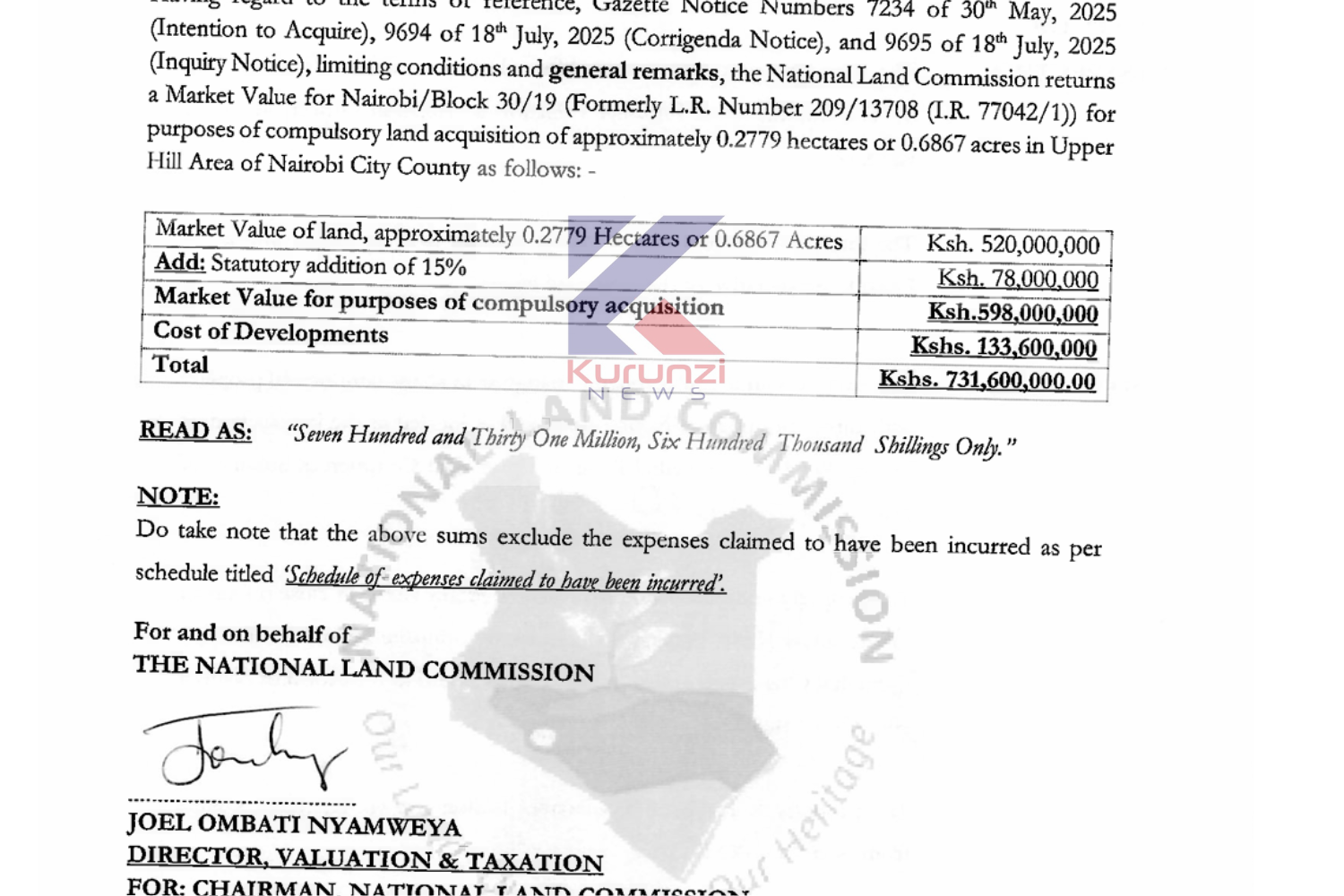
The existence of materially divergent valuations by two state agencies demands reasoned reconciliation, which has not been presented and is evidence of a lack of transparency in the process. This gap exposes a possible deliberate scheme to overvalue the land to the disadvantage of public interest.
According to the law, land valuation is not a discretionary guess. The Land (Assessment of Just Compensation) Rules require valuation to be evidence‑based, transparent, and defensible, considering market value, disturbance, severance, and provable loss.
Courts have annulled compensation awards like this where the valuation process is opaque or arbitrary.
Contradictions, inconsistencies, and questions
Regarding the ownership question, whether the land was public or private, the fundamental issue is how the NLC enforced Article 40 (6) of the Constitution which provides that unlawfully acquired land is not protected.
NLC’s own survey and analysis of public development plans from 1974, 1987, and 2005 shows the land was historically reserved public land, as noted by Nyamweya in his report when he states that “as per this PDP, the property is reserved for several Government Agencies and is, therefore, stated to be public land”.
First private registration of the land happened in 1998 when it was transferred to Quincy Store Ltd and went on to change hands severally – Autosilo Queensway Ltd (2006), Frontier Properties Ltd (2011), and finally Grassy Ltd in 2014.
This history of the land brings to the fore serious contradictions, inconsistencies, and rule-of-law questions.
How and what was the basis of alienating this land from public to private and how lawful was it? Was the land ever lawfully available for private ownership? Why did the NLC note due diligence but fail to show any substantive legal determination that the conversion from public to private was lawful?
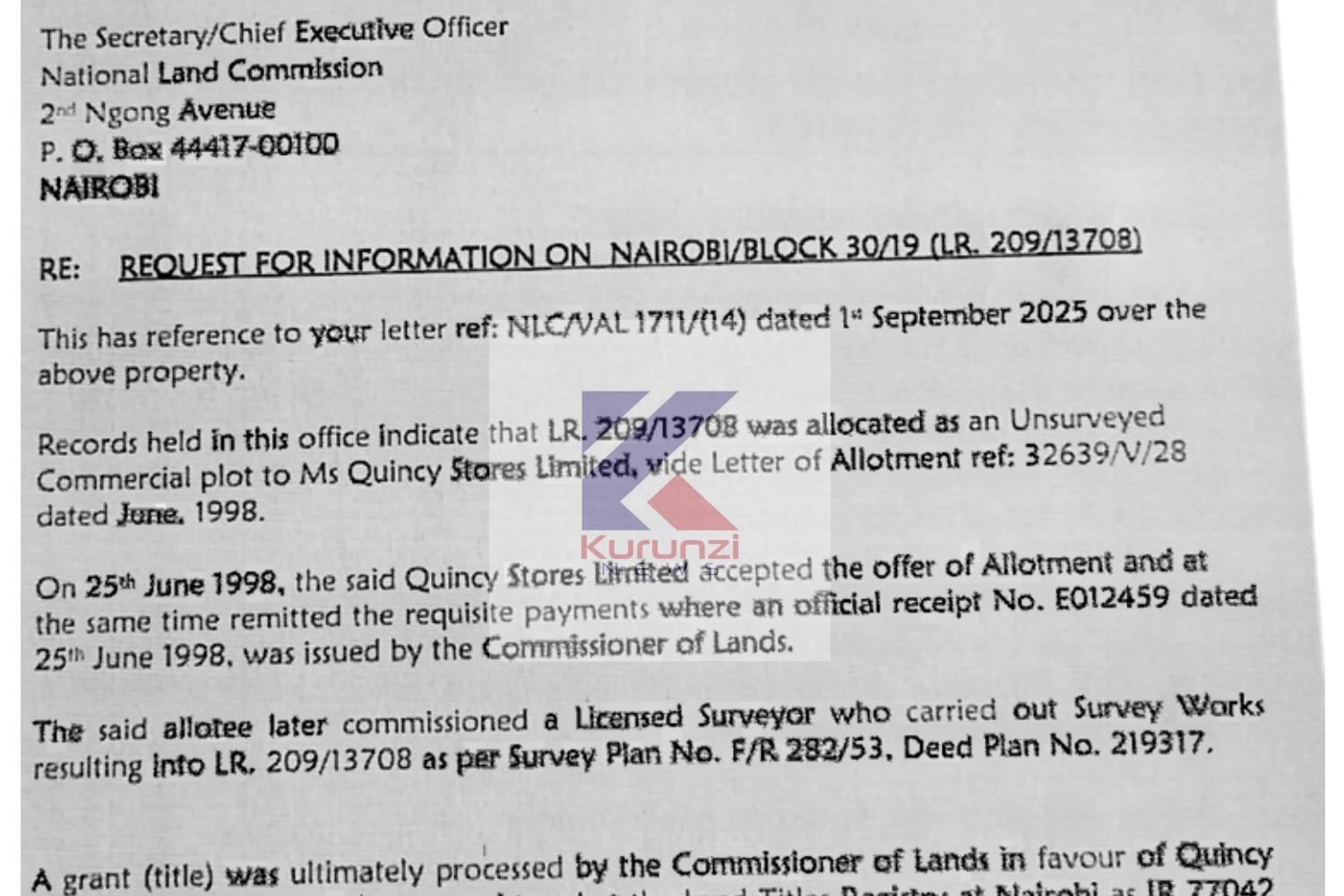
“It is questionable that the commission only relied on administrative evidence instead of pursuing other legal means of ascertaining how the property was transferred to private hands,” our source at NLC states, questioning the decision to focus on the quantum of compensation instead of the legality of the transfer.
“There are other legal means of interrogating the transfer chain in detail to establish the legality of the original grant from public to private. Instead of compensation at full market price, the commission should have considered alternative remedies like recovery of public land.”
The constitutional sequence of compulsory acquisition of land for public projects is such that legality must be established first, followed by valuation and payment last. In the present case, this legal order of things has been reversed by pricing the land before establishing its compensability.
Under Article 67(2)(e) of the Constitution, the NLC has the obligation to investigate present or historical land injustices and to protect public land, a requirement buttressed by the Land Act which empowers the Commission to decline or terminate acquisition processes that fail constitutional tests.
This power of the NLC has been reaffirmed severally by the Supreme Court and the Environment and Land Court, which have determined that irregular acquisition of public land cannot be sanitized through subsequent transfers. If the original alienation was unlawful, downstream titles are null and void.
From the face of it, this process checks all the procedural compliance boxes and statutory steps, namely, formal request by authorized national/county government officer, intention to acquire gazette, inquiry gazette and hearing and valuation, among others.
However, this apparent administratively neat processing of the compensation does not solve the puzzle of the legality of the land’s privatization and the payment approval in favor of Grassy Limited demonstrates the systemic blemish of how procedural shortcuts at the NLC are channels of embezzling billions of public monies.
One wonders why outgoing commissioners of a body that has been spending an average of KSh20 billion in compensation per year could approve KSh7.7 billion in one seating and proceed to request Treasury for a disbursement of ks11 billion plus as captured in the letter dated 25 October 2025. This is more than 50% of the total annual spending on compensation and cannot go without question.
Again, the billion-shilling question is why was this considered “extremely urgent” and in whose interest was this urgency?