

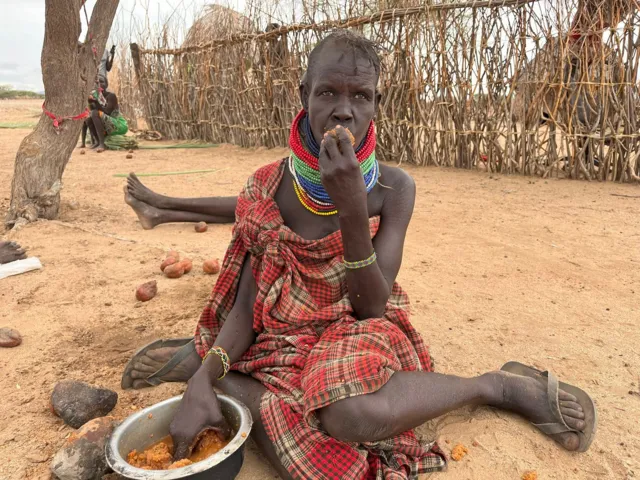
A prolonged drought in northern Kenya has forced families in Turkana County to survive on wild fruits known locally as mikwamo, highlighting a deepening hunger crisis across the region.
Lotkoy Ebey, a pastoralist in her early 50s, now owns just five goats, down from a herd of 50 that once sustained her family. Years of failed rains have wiped out livestock, which remain central to livelihoods in Turkana.
Across Kenya, Ethiopia and Somalia, about 26 million people are facing extreme hunger, according to Oxfam.
In Turkana County, dry riverbeds stretch across the landscape while grazing fields that once supported herds have turned barren. According to National Drought Management Authority, rainfall has been uneven and insufficient to reverse the impact of consecutive failed rainy seasons.
More than 320,000 people in the county are in urgent need of food assistance, officials say.
Turning to wild survival foods
With little food available, families are increasingly turning to the fruit of the doum palm, often referred to as the gingerbread tree because of its taste.
In Kakwanyang village, women gather under trees to pound the hard brown fruits into edible paste.
“We eat these because of hunger,” said Regina Ewute Lokopuu.
The fruit can provide temporary relief from hunger but carries health risks if consumed in large quantities, including stomach complications and drowsiness.
In better times, the fruit was eaten occasionally as a snack by children herding livestock. It has now become a primary food source for many households.
On rare occasions, families sell brooms made from doum palm leaves to earn small amounts of money, which they use to buy maize flour and mix with the fruit.
Aid stretched thin
Humanitarian assistance has declined in recent months, leaving many families without reliable support.
At a food storage facility near Lodwar operated by the Kenya Red Cross, workers load food supplies onto trucks for distribution to vulnerable households.
However, officials acknowledge that supplies are limited.
“We have only little food, which cannot reach all people in need,” said Rukia Abubakar, a coordinator with the organization.
Other agencies, including World Vision Kenya and the World Food Programme, are also providing assistance, but demand continues to outpace available resources.
The Kenyan government has announced plans to distribute food and livestock feed in drought-affected areas, though humanitarian officials warn that the scale of the crisis remains significant.
In Latimani village, about five kilometres away, residents say hunger has become a daily struggle.
Kerio Ilikol has gone three days without food, relying on neighbours for occasional meals.
“We don’t have food. We are very hungry,” said Akale Helen.
Many men have migrated with remaining livestock in search of pasture, leaving women, children and the elderly to cope with worsening conditions.
Despite recent rainfall in parts of Kenya, experts caution that it may not bring immediate relief. Officials warn the rains could be short-lived and insufficient to restore pasture or water sources.
Across Kenya, about three million people are affected by drought, with Turkana among the hardest-hit regions.
For families like Ebey’s, survival depends on limited resources and what can be found in the wild.
Until consistent rainfall returns and aid reaches more households, communities are expected to continue relying on fragile coping mechanisms.
BBC