Climate Injustice: Why Africa Pays the Highest Price
 March 20, 2026
10 min read
March 20, 2026
10 min read

Ali Liban Guracho walks past dozens of dead cattle outside Garissa, Kenya. Photo Credit: Larry C. Price
Despite contributing less than 4 percent of global carbon dioxide emissions, Africa now endures the planet’s most severe climate disruptions — flooding, record heat, catastrophic drought, and mass displacement — as wealthier nations stall on promised financial relief.
On a per-capita basis, the average African emits roughly one metric ton of carbon dioxide per year. The average American or Australian emits the same in a single month. That arithmetic should settle any argument about who bears moral responsibility for the climate emergency now tearing across the African continent — yet the global response remains tragically misaligned with that reality.
“The State of the Climate in Africa report reflects the urgent and escalating realities of climate change across the continent. It also reveals a stark pattern of extreme weather events, with some countries grappling with exceptional flooding caused by excessive rainfall and others enduring persistent droughts and water scarcity.”
— WMO Secretary-General Celeste Saulo, May 2025
— WMO Secretary-General Celeste Saulo, May 2025
Africa’s Disproportionate Burden
The numbers make the injustice plain. The Intergovernmental Panel on Climate Change has confirmed that Africa has historically contributed little to the climate crisis but bears a wildly disproportionate burden of its worst impacts. According to the African Development Bank, citing the 2022 Climate Vulnerability Index, nine of the world’s ten most climate-vulnerable countries are in Sub-Saharan Africa. A Down to Earth analysis of EM-DAT data found that between 2021 and 2025 alone — just five years — at least 221 million people across the continent were affected by extreme weather disasters, with nearly 29,000 lives lost: more than three times the death toll of the previous five-year period.
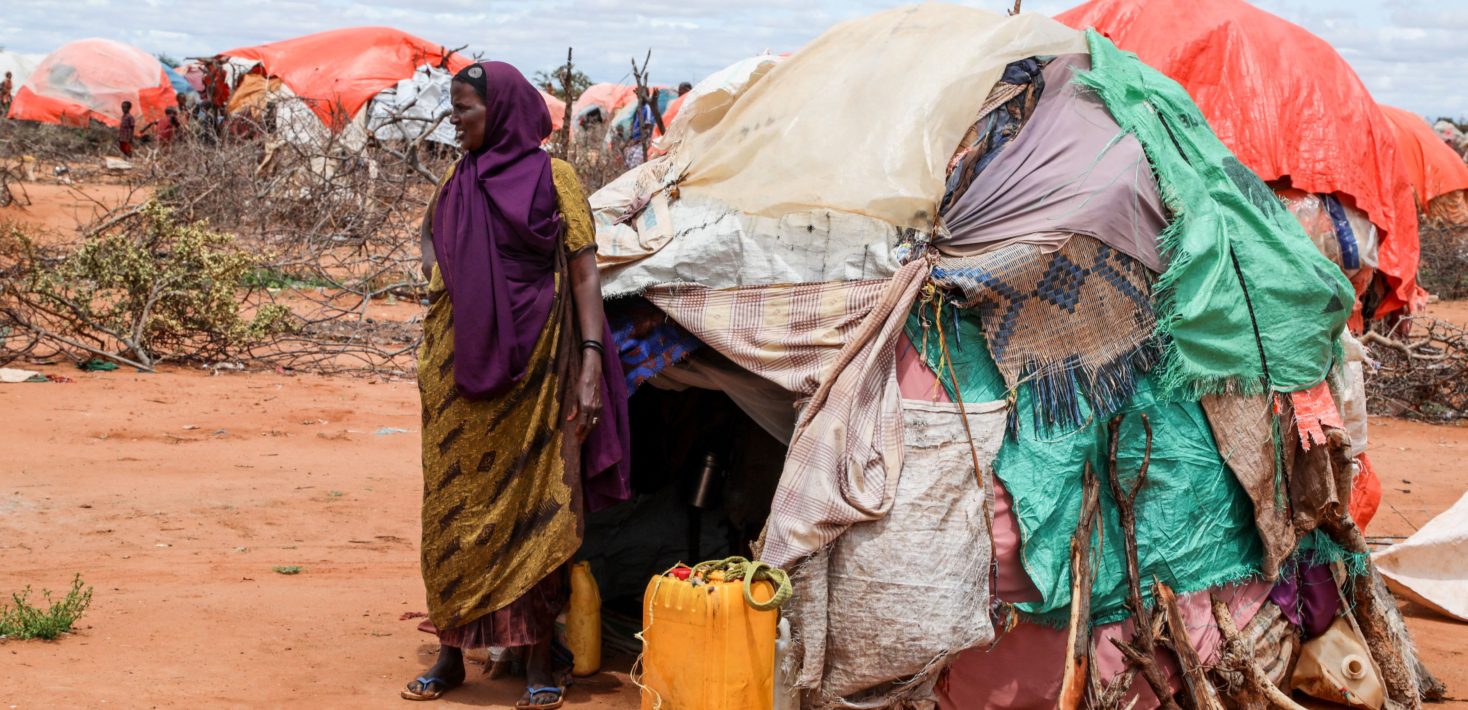
The Internal Displacement Monitoring Centre reported in late 2024 that climate-related disasters are driving displacement across Africa at a pace six times higher than 15 years ago. In the Horn of Africa, five consecutive failed rainy seasons between 2020 and 2023 displaced more than 2.7 million people across Ethiopia, Kenya, Somalia, and Djibouti — with Somalia alone accounting for 1.4 million of those internally displaced, according to IOM and OCHA. In East Africa, exceptionally heavy rains between March and May 2024 triggered catastrophic flooding in Kenya, Tanzania, Burundi, and other parts of the region, killing hundreds and affecting more than 700,000 people, according to the WMO. In the same year, Malawi, Zambia, and Zimbabwe suffered the worst drought in at least two decades, leaving 27 million people — including 21 million children — facing acute food insecurity, according to WMO and the World Food Programme.
The Brookings Institution’s Foresight Africa 2024 report estimated that over 110 million people were impacted by the climate crisis across the continent in 2022, while food inflation reached its highest levels in three decades — averaging 30 percent across the region, compounded by the disruptions caused by the war in Ukraine. Nearly 282 million people, representing about 20 percent of Africa’s total population, are already undernourished. The Center for Global Development has warned that more than 200 million people could face extreme hunger in the long run as extreme weather events compound the damage to crop yields and farmland. Droughts alone are projected to push more than 50 million people into water distress.
By the Numbers: Africa’s Climate Reality
- Africa’s per capita CO₂ output: ~1 tonne/year vs. 10.3 tonnes for North America
- 2024: warmest or second-warmest year on record for Africa, per WMO dataset
- North Africa warming at 1.28°C above 1991–2020 average — fastest sub-region
- Southern Africa: aggregate cereal yields 16% below 5-year average in 2024; Zambia down 43%, Zimbabwe down 50% (WMO)
- Agriculture accounts for ~15–17% of Sub-Saharan Africa’s GDP (World Bank, 2023); employs over 60% of the continent’s workforce
- 10 countries in Africa received 46% of all tracked climate finance (2021/22)
- Only 18–20% of Africa’s annual mitigation and adaptation needs are being met
The Climate Finance Gap
The financial dimension of climate justice may be where the gap between rhetoric and reality is most glaring. At every major climate summit since Copenhagen in 2009, wealthy industrialized nations have promised billions — and then consistently underdelivered. The landmark pledge of $100 billion per year from developed nations to the developing world was first announced at COP15 in Copenhagen, formally adopted at COP16 in Cancun in 2010, and reaffirmed and extended to 2025 under the Paris Agreement. The goal was not met by its original 2020 deadline — it was finally reached in 2022, two full years late, according to the OECD — and even then, critics including Oxfam and developing-country negotiators disputed the accounting, arguing that much of what was counted included market-rate loans rather than genuine grants. More critically, $100 billion represents only a fraction of what Africa actually needs: the OECD figure encompasses all developing nations globally, while Africa’s share remains highly concentrated in just a handful of countries.
The Climate Policy Initiative’s Landscape of Climate Finance in Africa 2024 offers a sobering assessment. While climate finance to the continent did increase — crossing the $50 billion mark for the first time in 2022, and reaching $43.7 billion in 2021/22, a 48 percent increase from 2019/20 — the investment gap remains enormous. Only about 18 percent of Africa’s annual mitigation needs and 20 percent of its adaptation needs are currently being met. Of the funding required to implement African nations’ Nationally Determined Contributions and reach their 2030 climate goals, only 23 percent of the estimated annual requirement is even being tracked, let alone disbursed.
What makes the situation more troubling is where what little money does flow actually lands. International climate finance is heavily concentrated in a small number of African nations: the top ten recipient countries captured 46 percent of all tracked funding, while the ten most climate-vulnerable African countries received only 11 percent. In private climate finance, the imbalance is even sharper — ten countries received 76 percent of all private investment flows, leaving the continent’s most exposed communities with the least support. As the WMO’s 2023 Africa climate report noted, African countries are on average losing 2 to 5 percent of their GDP annually while also diverting up to 9 percent of their budgets responding to climate extremes. The cost of adaptation across sub-Saharan Africa alone is estimated at $30 to $50 billion every year.
“Africa already faces a steep climate change bill. For a continent still struggling economically, this is a dangerous risk multiplier.”
— Dr. Dawit Solomon, CGIAR Climate Research for Africa (AICCRA)
The Nairobi Declaration, adopted at the close of the inaugural Africa Climate Summit in Nairobi on September 6, 2023, was explicit in framing this as a justice issue. African leaders urged world leaders to rally behind a global carbon taxation regime — covering fossil fuel trade, maritime transport, and aviation — augmented by a global financial transaction tax, with the proceeds dedicated to climate finance for the developing world. At successive COP negotiations, they have leveraged their collective voice within the G-77 bloc — 134 member nations representing roughly two-thirds of the world’s population — to press for better terms. Progress has been incremental at best.
Heat, Displacement, and Human Cost
A joint analysis by World Weather Attribution, the Red Cross Red Crescent Climate Centre, and Climate Central found that between May 2024 and May 2025, nearly half the world’s population — approximately 4 billion people — endured an extra 30 days of temperatures that surpassed the hottest 10 percent of days recorded between 1991 and 2020. In 195 countries and territories, climate change at least doubled the number of extreme heat days compared to a world without human-induced warming. Africa bore a particularly heavy share: at least 14 of the 67 identified extreme heat events globally occurred in Africa, and 10 African countries experienced more than 90 extraordinarily hot days in a single year — Burundi, Comoros, the Congo, Equatorial Guinea, Gabon, Ghana, Liberia, Mayotte, Rwanda, and São Tomé and Príncipe.
Southern Africa experienced four extreme heat events in 2024 alone, some of which were found to be up to nine times more likely to occur because of human-induced climate change. Lake Kariba — Africa’s largest man-made reservoir by volume, straddling the border of Zambia and Zimbabwe — fell to critically low water levels, triggering prolonged power outages and economic disruption across two countries that depend on hydroelectric power. In Zambia, the blackouts were the worst in living memory, crippling hospitals, schools, and businesses that were already struggling.
Compounding the agricultural devastation, sea surface temperatures around the African continent reached record levels in 2024, with particularly rapid warming in the Atlantic Ocean and the Mediterranean Sea, according to the WMO. Marine heatwaves of strong, severe, or extreme intensity affected almost the entire ocean area surrounding Africa — covering nearly 30 million square kilometres between January and April 2024, the largest area impacted since monitoring began in 1993. This warming disrupts marine ecosystems, intensifies tropical storms, and pushes coastal and fishing communities into deeper crisis. Meanwhile, the agriculture sector — which accounts for roughly 15 to 17 percent of GDP across Sub-Saharan Africa yet employs over 60 percent of the continent’s workforce through rain-fed, low-yield farming — remains acutely exposed to every fluctuation in rainfall and temperature.
The continent’s rapid urbanization adds another dimension of vulnerability. As millions move from rural areas into cities in search of economic opportunity, they often end up in informal settlements without adequate drainage, cooling infrastructure, or access to clean water. When a flood hits — as in Maiduguri, Nigeria, in September 2024 — those communities absorb the worst of it, losing homes, livelihoods, and family members in a matter of hours.
Emerging technological tools offer some measure of hope. Several African National Meteorological and Hydrological Services are now using artificial intelligence to monitor and predict localized weather hazards. Nigeria and Kenya are leading the way in digital climate communication, deploying mobile applications, cell broadcast alerts, and community radio systems to deliver early warnings to remote agricultural and fishing communities. South Africa has adopted AI-based forecasting systems and modern radar infrastructure. But as the WMO has emphasized, these advances remain fragmented, underfunded, and far short of what is needed for a continent of 1.4 billion people.
The scale of the moral and political failure on display here is hard to overstate. Africa has contributed the least to the greenhouse gas emissions that are destabilizing its climate, yet it pays the highest price in human suffering. Its farmers did not burn the coal that warmed the Atlantic. Its herders did not fill the atmosphere with industrial exhaust. Its children did not choose to inherit a world where the rains no longer come on time, where the lakes are drying up, and where the heat can close a school in March.
Climate justice is not a slogan. It is an accounting. And by any honest measure, the ledger is badly out of balance — and the cost of continuing to ignore it is being paid every day, in lives and livelihoods, across a continent that asked for none of this.

Related Articles