
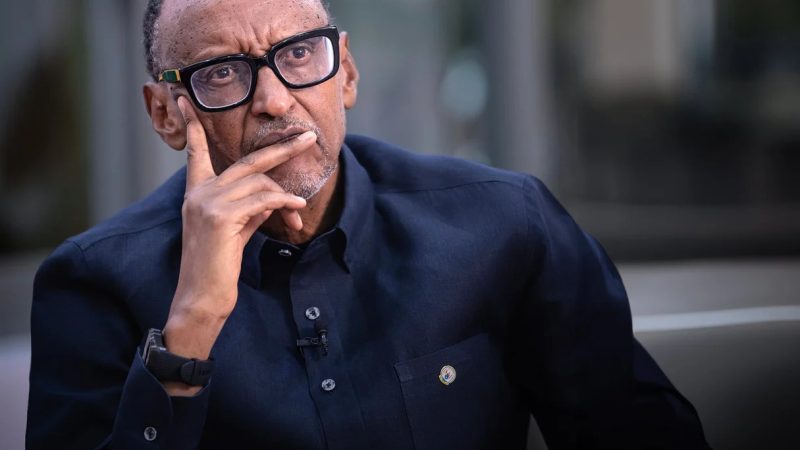
Rwandan President Paul Kagame has defended his country’s continued military posture in eastern Democratic Republic of Congo, insisting Rwanda will not withdraw its forces while security threats persist along its border.
In a wide ranging interview with Jeune Afrique, Kagame said Rwanda actions are strictly defensive, aimed at countering the threat posed by the Democratic Forces for the Liberation of Rwanda, a militia group with roots in the aftermath of the 1994 genocide.
“Don’t expect me to lift our defense measures while you let Félix Tshisekedi do what he wants,” Kagame said, referring to the president of the Democratic Republic of Congo.
The remarks come months after a United States brokered peace agreement signed in Washington that sought to ease tensions between Kigali and Kinshasa. Despite that deal, fighting and instability continue in eastern Congo, highlighting the fragile nature of regional diplomacy.
Security tensions and regional pressure
Kagame said Rwanda military presence is driven by ongoing threats along its border, emphasizing that defensive measures may include troop deployments and operations beyond its territory to prevent attacks.
“If I defend my border and for that it is necessary to address the threat five, 10, or 20 kilometers beyond, it remains a defensive measure,” Kagame said.
The Democratic Forces for the Liberation of Rwanda remains a key concern for Kigali. Rwanda has long accused Congo government of tolerating or cooperating with the armed group, which it considers a direct threat.
Kagame criticized what he described as unequal international pressure, arguing that Rwanda is being singled out while Congo internal security issues are ignored.
“You cannot expect one party to fulfill all of its obligations while the other fulfills them only partially or not at all,” he said, referring to the Washington agreement.
The United States has imposed sanctions on Rwanda defense forces and several military officials over alleged support for the M23 rebel group. Kagame rejected the sanctions, saying they are unjustified and reflect political interests rather than facts.
“I don’t accept sanctions whose basis I don’t understand,” he said.
The role of the M23 rebel group remains a major point of dispute. Kagame denied that M23 is backed by Rwanda, describing it as a Congolese movement that requires a political solution within Congo.
However, Rwanda has acknowledged security coordination in the region, which many interpret as confirmation of its military presence in eastern Congo.
Kagame also said the situation along the border has improved from a security standpoint, pointing to control of key areas by M23 forces as reducing threats to Rwanda.
“From a security standpoint, it is a clear fact. Our entire border with the DRC is now secured,” he said.
The conflict in eastern Congo continues to involve multiple actors, including regional governments and armed groups, making resolution difficult. Kagame called on the international community to apply balanced pressure on both Rwanda and Congo.
Despite diplomatic efforts, tensions remain high and there is little sign of a quick resolution. Kagame remarks indicate Rwanda is unlikely to withdraw its forces soon, as long as it perceives ongoing threats from armed groups operating in eastern Congo.